
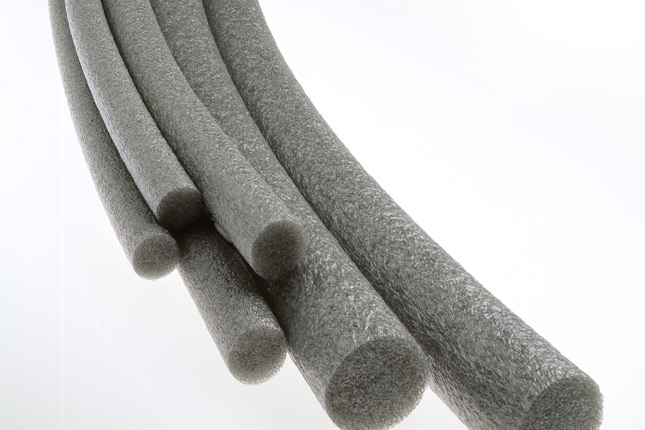
Construction foam covers a family of polyethylene and polyurethane products with three main jobs on a building project. It backs and fills expansion joints in concrete and masonry, insulates against heat and sound under screed and in walls, and seals voids around frames and service penetrations. Each job needs a specific foam type and cell structure, and choosing the wrong one weakens the joint or the building envelope.
iFoam supplies contractors, builders and engineers with building and construction foam from its Cape Town and Durban branches, including backing cord, Jointformex expansion joint strip, Aquajoint high-density joint filler and polystyrene.
What Is Construction Foam? (And Why One Product Does Not Cover Everything)
Construction foam comes in two main chemistries: polyethylene (PE) and polyurethane (PU). The chemistry decides if the foam is closed-cell or open-cell, and the cell structure decides where it performs on site.
Closed-cell foam has sealed, separate cells. It resists water, keeps its shape under compression and does not let liquid pass through. Open-cell foam has connected cells that let air and moisture move through, which helps it absorb sound but limits its use in wet or load-bearing positions. The open-cell vs closed-cell foam guide explains the difference in more detail.
On site, construction foam falls into three categories. The first is joint backing and filler: backer rod and compressible strip used in expansion joints before sealant goes in. The second is insulation: closed-cell boards and strips used under screed, in cavity walls and at slab edges. The third is reactive void fill: spray PU foam used to seal around penetrations, frames and service ducts.
Specifying by category, not by a generic product name, avoids the wrong product being substituted on site.
Expansion Joint Filler and Backer Rod: Getting the Joint Right
Expansion joints are deliberate gaps built into concrete and masonry so the structure can move with heat, load and settlement. Without them, restrained concrete cracks wherever the stress finds a weak point. The joint gives that movement a controlled place to happen, and to work it must be sealed against water while staying compressible.
Backer rod, also called backing cord, is a closed-cell polyethylene foam cord pushed into the joint before the sealant is applied. It controls how deep the sealant sits, stops three-sided adhesion and gives the sealant a firm backing to form its proper shape against.
Three-sided adhesion is the failure that backer rod prevents. If sealant bonds to both joint faces and the bottom of the joint at the same time, it cannot stretch when the joint moves, and it tears instead. Backer rod blocks the bond at the bottom so the sealant only grips the two side faces and can stretch and compress as the joint opens and closes.
Backer rod comes in a wide range of diameters to suit different joint widths. The right diameter depends on the width of the joint. For joints of about 19 mm and wider, the rod should be roughly 25 to 30 per cent wider than the joint, so it compresses in by hand and stays in place against both faces.
A bond-breaker tape is sometimes laid at the base of the joint before the rod goes in, where the base material would otherwise bond to the sealant. In most joints the backer rod itself gives enough bond break.
Choose the sealant to suit the substrate, the expected movement and the exposure, and confirm with the sealant manufacturer that it is compatible with the backer rod, as polyurethane and silicone sealants behave differently.
How to Install Backer Rod in an Expansion Joint
Installation follows the same four steps whatever the joint width or sealant:
- Clean all loose debris, dust and laitance out of the joint. Dirt on the joint faces weakens the sealant bond and leads to early failure.
- Choose the right diameter: roughly 25 to 30 per cent wider than the joint for joints of about 19 mm and wider. The rod should press in by hand and hold without slipping.
- Press the rod in to a depth that leaves room above it for the sealant, as specified by the sealant manufacturer. Too little sealant depth limits stretch; too much wastes sealant.
- Apply a compatible sealant over the rod and tool it so it bonds to the two side faces only. Avoid pressing so hard that sealant is forced under the rod, which would bring back three-sided adhesion.
Choosing the Right Backer Rod Diameter
The 25 to 30 per cent oversize rule for joints of about 19 mm and wider is the usual starting point. For a 20 mm joint, choose rod of about 25 to 26 mm. For a 30 mm joint, choose about 38 mm.
Joint widths in South African commercial work vary a great deal. Light precast elements have narrow joints, while heavy industrial slabs and podium decks have wide ones, and the rod size follows the same rule throughout.
Backer rod for expansion joints must be closed-cell polyethylene. Open-cell rod soaks up sealant, leaving less in the joint and weakening the bond where foam meets sealant. Closed-cell rod stays the same size and gives a clean backing.
PE Foam in Construction: Beyond the Backer Rod
Closed-cell polyethylene foam does far more on a building site than back up sealant. It absorbs little water, does not react with most chemicals, springs back after compression and stays consistent across temperatures.
Expansion joints in brick and block walls. iFoam’s Jointformer and Jointformex closed-cell foam strip forms expansion joints between brickwork and columns, compressing as the wall moves while giving the sealant a backing.
Acoustic isolation strips. PE foam strips placed between a slab edge or wall base and the screed break the solid path for impact noise, so footfall on the screed is not passed straight into the structure.
Underlay beneath screed. Closed-cell PE sheet laid across the full slab creates a floating layer that cuts impact sound through the floor and adds a small thermal break between screed and concrete.
Void formers. PE foam can hold a void shape in drainage channels and service ducts during a concrete pour, and is either removed afterwards or left as a compressible liner.
Shutterstrip. Foam strip between bolted shutter panels stops grout leaking out during a pour. iFoam supplies this as Shutterstrip, also known as Groutex.
For PE foam in sheet and strip form, see iFoam’s closed-cell foam sheets, or compare the two main chemistries in the guide to PE foam vs PU foam.
Polyurethane Foam in Construction: Void-Fill and Structural Applications
Polyurethane foam differs from polyethylene at the chemical level because PU is reactive. One-component spray PU cures by reacting with moisture in the air. Two-component systems mix two liquids at the nozzle and start a curing reaction. Either way, the foam expands to fill the space and then sets in place.
That makes spray PU the standard product for void fill. Typical jobs are the gap around window and door frames, pipe penetrations through walls and slabs, openings around service ducts, and irregular voids that cannot be measured accurately in advance.
Closed-cell spray PU, applied at the right thickness, gives both an air seal and vapour control, which is useful in building envelopes where heat loss and draughts are both being tackled.
Flexible PU slab is also used in some bearing pad and slab support jobs where controlled give under sustained load is needed.
The key caution with spray PU is expansion. Aerosol foam expands a great deal as it cures, and how much depends on the product, the temperature and the moisture in the substrate. Allow for it when filling a void, or the foam will push out of the joint, frame or penetration.
Open-cell PU foam is not suited to exposed outdoor joints or areas that get wet. It absorbs moisture, breaks down over time and weakens the sealant bond.
PE Foam vs PU Foam in Construction Applications
| Property | PE Foam (Polyethylene) | PU Foam (Polyurethane) |
|---|---|---|
| Cell structure | Closed-cell | Open-cell or closed-cell |
| Water absorption | Very low | Low (closed-cell) or moderate (open-cell) |
| Main forms | Cord, strip, sheet, board | Spray, slab, board |
| Main construction use | Backer rod, joint strip, acoustic break, underlay | Void fill, air seal, slab support |
| Compressibility | Good: recovers after load | Varies by grade |
| Behaviour on application | Inert (pre-formed, stable) | Reactive (expands as it cures) |
Foam as Thermal and Acoustic Insulation in Buildings
This section covers foam insulation only: closed-cell and open-cell foam boards, strips and spray systems.
Thermal performance is measured by R-value, the resistance to heat flow, in m²·K/W. Closed-cell foam boards give useful insulation in a small thickness, which suits cavity walls and thermal breaks below screed where depth is limited. iFoam supplies polystyrene for void filling and thermal insulation, which helps keep buildings cooler in summer and warmer in winter.
SANS 10400-XA sets the minimum thermal performance of South African building envelopes and divides the country into climate zones, each with minimum R-values for roofs and walls. Specifiers must identify the climate zone and confirm that the chosen insulation, at the chosen thickness, brings the whole assembly up to the required total R-value, counting every layer.
Foam works on sound in two different ways. Open-cell foam absorbs sound within its connected cells, which reduces echo inside a room; this is sound treatment. Closed-cell foam creates a break in stiffness between building elements, which stops noise crossing from one space to another; this is sound isolation. The guide to soundproofing vs sound absorption covers the difference in more depth.
In slab construction, the closed-cell PE strip between slab edge and screed is an acoustic break, not an absorber. It interrupts the rigid connection that would otherwise carry impact noise from the screed into the structure. Knowing which job the foam is doing decides which product fits an acoustic specification.
South African Compliance and Specification Considerations
SANS 10400 is the South African National Building Regulations code, and Part XA covers energy efficiency. Foam used for insulation must help the building element meet the R-value required for its climate zone.
Foam used in fire-rated assemblies must have the right fire classification. Specifiers must confirm that the product has been tested to the relevant SANS fire standard and that using it does not compromise the assembly’s fire rating.
Specification documents should name foam by function rather than by a generic name. Backer rod, insulation board and acoustic break strip are different product families with different density, compressibility and fire performance, and swapping one for another on site without re-specification creates compliance risk.
Key Terms Explained
Expansion joint: A deliberate gap in a concrete or masonry structure that lets it move with heat, load or settlement. It must be sealed against water while staying compressible across its design movement.
Backer rod (backing cord): A closed-cell polyethylene foam cord pushed into an expansion joint before sealant goes in. It controls sealant depth, prevents three-sided adhesion and supports the sealant shape.
Three-sided adhesion: The failure where sealant bonds to both side faces and the base of the joint at once. It stops the sealant stretching, so it tears when the joint moves.
SANS 10400-XA: Part XA of the South African National Building Regulations, covering energy efficiency of building envelopes. It sets minimum R-values for roofs and walls by climate zone.
Closed-cell foam: Foam whose cells are sealed off from each other, so it stays dry inside and holds its shape under load.
Open-cell foam: Foam with connected cells that let air and moisture through. It absorbs sound but is not suited to wet or load-bearing positions without a protective face.
R-value: A measure of resistance to heat flow, in m²·K/W. The higher the value, the better the insulation.
Acoustic break: A break in a building element that stops impact or structure-borne noise travelling through it, such as a closed-cell PE strip between screed and slab edge.
Void fill: Using reactive foam, usually one-component spray PU, to fill irregular gaps around penetrations, frames or services. The foam expands and sets to fill the space.
Resources
- SANS 10400-XA, Energy usage in buildings, South African Bureau of Standards.
- iFoam, building and construction products.
- iFoam, closed-cell foam sheets.
- iFoam, PE foam vs PU foam.
- iFoam, open-cell vs closed-cell foam guide.
- iFoam, how to install IBR roof closures.
Frequently Asked Questions
What is the difference between backer rod and expansion joint filler?
Backer rod is a closed-cell PE foam cord pushed into an expansion joint before sealant goes in, to control sealant depth and stop three-sided adhesion. “Expansion joint filler” is used loosely on site. Sometimes it means backer rod, and sometimes it means compressible foam strip or board that fills the full joint depth, such as Jointformex in brickwork or high-density filler in water-retaining structures.
Can I use any foam as a backer rod?
No. Backer rod must be closed-cell polyethylene. Open-cell foam soaks up sealant, leaving less in the joint and contaminating the bond, which leads to early failure. Specify closed-cell PE backing cord by diameter and confirm it is intended for sealant joints.
Does foam insulation comply with SANS 10400-XA?
Compliance depends on the R-value of the whole building assembly, not on one product. Foam insulation adds to that total, and the specifier must confirm that every layer together meets the minimum for the climate zone and building element. Foam on its own does not guarantee compliance.
What foam do I use under screed for acoustic isolation?
Use closed-cell PE foam sheet laid across the full slab before the screed is poured. It creates a floating layer that separates the screed from the slab and interrupts the path for impact noise. Lay it continuously with lapped joints, and turn it up at the perimeter before the screed goes in.
Is polyurethane spray foam suitable for outdoor expansion joints?
No. Standard one-component PU spray foam is not UV stable and breaks down in prolonged sun, losing adhesion and flexibility. For outdoor movement joints, use closed-cell PE backer rod at the right diameter with a sealant made for outdoor movement joints, and confirm UV stability and movement class with the sealant manufacturer.
What is the difference between open-cell and closed-cell foam in construction?
Open-cell foam has connected cells that let air and moisture through; it absorbs sound and suits indoor acoustic treatment. Closed-cell foam has sealed cells; it resists water, holds its shape under load and blocks rather than absorbs sound. For anything wet, loaded or outdoors, closed-cell foam is the right choice.
How do I choose the correct backer rod diameter?
For joints of about 19 mm and wider, choose a rod roughly 25 to 30 per cent wider than the joint so it compresses in and stays put. For a 25 mm joint that means about 32 mm rod; for a 40 mm joint, about 50 mm. For narrower joints, check the sizing with your supplier, as the ratio can differ.
What is an acoustic break in a concrete slab?
An acoustic break is a compressible foam strip, usually closed-cell PE, placed at the slab perimeter between the screed and the structure before the screed is poured. It stops the screed touching the walls and slab edge rigidly, so impact noise on the floor is not passed into the building. It isolates sound rather than absorbing it.
Can foam insulation boards be used in cavity walls?
Yes, provided the board meets the fire classification needed for the wall assembly and contributes the R-value required under SANS 10400-XA. It must also work with the wall ties, damp barriers and render in the assembly. Confirm the fire classification with the supplier before specifying.
How does closed-cell PE foam compare to XPS board for insulation?
Both are closed-cell, absorb little water and resist compression. XPS usually insulates better per millimetre. PE foam springs back better after load, which makes it the better choice for acoustic breaks and underlay where it is compressed repeatedly. Choose XPS where insulation per millimetre matters most, and PE where recovery and sound isolation matter.
What SANS standards apply to foam products in buildings?
SANS 10400-XA covers the thermal performance of building envelopes. For fire performance, the standard depends on the assembly and the fire rating required. Any foam used in a fire-rated assembly must have documented fire test data, and specifiers should ask the supplier for it during material approval.
How long does backer rod last in an expansion joint?
Closed-cell PE backer rod does not react with most chemicals or absorb water, so it lasts a long time inside a sealed joint. The sealant above it is usually what wears out first. When a joint is resealed, the existing rod is normally left in place as long as it is still intact.
Sourcing Construction Foam in South Africa
When ordering construction foam, state the product type (backing cord, joint strip, board or spray foam) and the cell structure. Add the dimensions (diameter for cord, width and thickness for strip and sheet), any density or compressive strength grade, and what it is for. Ordering by application rather than by a site nickname reduces the risk of the wrong product arriving.
iFoam supplies contractors and builders from Cape Town and Durban with backing cord (Polycord), Jointformer and Jointformex joint strip, and Shutterstrip (Groutex). The range also includes Aquajoint high-density joint filler for dams and reservoirs, roof closures, rebar spacers and polystyrene. See the full building and construction range to enquire.
Final Thoughts
The most important decision with construction foam is matching the cell structure to the job. Expansion joints need closed-cell PE backer rod to stop three-sided adhesion. Insulation needs a board or strip of the right grade and a verified R-value for the climate zone. Void fill around penetrations needs a reactive PU product sized to the gap. Get those three right and the joints, walls and floors perform as designed. For the full range of jointing, sealing and insulating products, contact iFoam about its construction foam.