
undefined

Interlocking Rubber Mats and Floor Tiles

Interlocking rubber mats, EVA foam mats and PVC floor tiles that lock together without adhesive. Lay any footprint, lift out a single tile when it wears, supplied from our Cape Town and Durban floors and delivered across South Africa.

A floor you can lay, extend and repair

Interlocking flooring solves two problems at once. You are not cutting a continuous sheet to fit an awkward room, and when one section takes damage you replace that section rather than the whole floor.

We supply three interlocking systems: EVA foam mats for gyms and play areas, PVC floor tiles for general industrial and commercial floors, and heavy duty rubber mats where the surface has to take real punishment.

All three lock on their own edges, so no adhesive is needed and the floor can be lifted and relaid when the room layout changes.
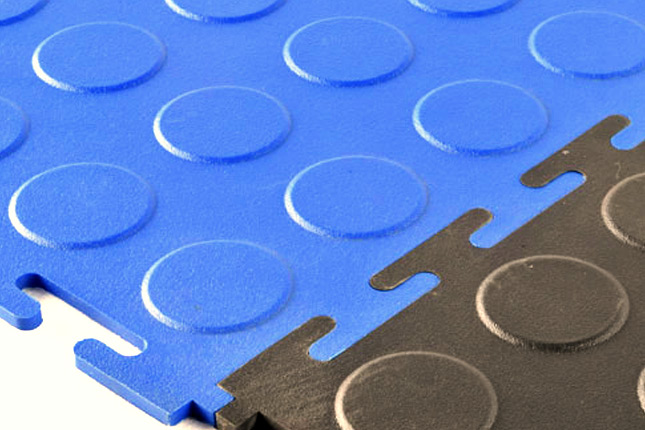
Blue and black interlocking PVC industrial floor tiles with a studded surface

Three interlocking systems

Pick by how much punishment the floor takes.

Interlocking EVA foam mats20mm thick, 1m x 1mDense, durable foam mats for gyms and play areas, in dual colour blue and grey. Cushioned underfoot and warm to stand on.
PVC interlocking floor tiles4mm thickHard wearing rubber tiles for general industrial and commercial floors. The thin profile means the floor level barely changes.
Rubber Linkmat16mm thickThe heavy duty interlocking rubber mats. They link into a continuous cover and are widely used as bar matting and commercial kitchen flooring.
Any footprintLaid to your areaBecause the tiles connect to each other, the finished floor follows the room instead of a fixed sheet size.

Rubber floor tiles against sheet flooring

Damage stays local. One burnt, torn or worn rubber tile lifts out and a replacement drops in. The same damage to a bonded sheet floor usually means relaying a much larger area, and the repair is always visible.

No adhesive, no downtime. Interlocking rubber mats go down dry. There is no curing time, no fumes and no waiting before the room can be used, which matters in a working gym, kitchen or workshop.

The floor moves with you. Rubber tiles lift and relay, so a floor bought for one room can follow the business into the next one. A bonded floor is a fixture you leave behind.

Awkward rooms stop being a problem. Pillars, alcoves and odd angles are handled by trimming edge tiles rather than templating a whole sheet.

Where each one fits

Gyms and play areasEVA foam mats. Cushioned, warm, and safe for training and for children.
Workshops and commercialPVC rubber tiles. Durable, thin, and easy to lay over an existing floor.
Kitchens, bars and wet areasRubber Linkmats. Heavy duty with drainage through the mat.
Free weight areasHeavy rubber matting that absorbs dropped weight and protects the slab.
Warehouse walkwaysInterlocking rubber mats that take constant foot traffic without curling at the edges.
Standing workstationsAnti-fatigue matting where people stand in one place through a shift.
Give us the room dimensionsWe work out the tile count, the layout and the price, and tell you which of the three suits the way the floor gets used.

Request a quote

Frequently Asked Questions

How thick are your interlocking rubber mats and foam mats?
The interlocking EVA foam gym and play mats are 20mm thick in 1m x 1m tiles. The rubber Linkmats are 16mm. The PVC interlocking floor tiles are 4mm, which keeps the floor level almost unchanged where that matters.
Do interlocking rubber floor tiles need adhesive?
No. They lock on their own edges, which is the main reason people choose them. The floor goes down dry with no curing time, and it can be lifted and relaid when the room changes or the business moves.
What is the difference between the foam mats and the PVC tiles?
The EVA foam mats are 20mm and cushioned, which suits gyms and play areas. The PVC rubber tiles are 4mm and rigid, which suits workshops and commercial floors where you want durability without raising the floor level.
Can I lay rubber tiles in an odd shaped room?
Yes, and that is the main reason people choose them. The tiles connect to one another so the floor follows the shape of the room, and edge tiles can be trimmed to finish neatly against a wall, pillar or alcove.
What happens when one tile gets damaged?
You lift that tile out and drop a replacement in. With a bonded sheet floor the same damage usually means relaying a much larger area. It is one of the main reasons interlocking rubber mats work out cheaper over the life of a floor.