
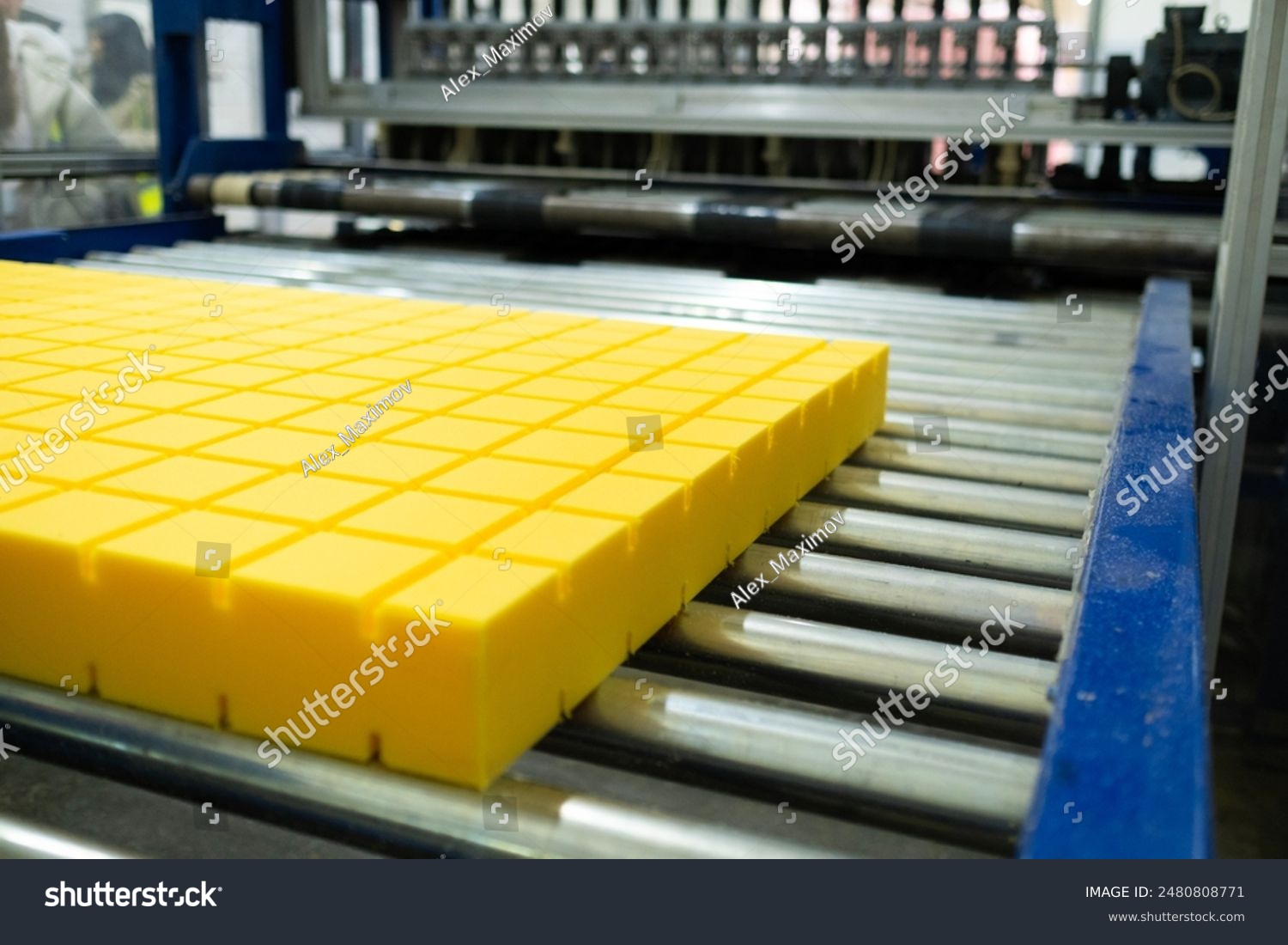
Kaizen foam is a dense, precision-profiled foam insert placed inside tool drawers, rolling cabinets, and equipment cases to hold each tool in a fixed, visible location. Its primary use is tool control and visual management in workshops, manufacturing facilities, aviation maintenance, and automotive environments.
iFoam has supplied industrial foam solutions across South Africa since 1997, cutting custom inserts by die-cutting, CNC, and laser from its Cape Town and Durban branches.
What Is Kaizen Foam?
Kaizen foam is a dense, closed-cell or semi-rigid foam profiled to hold specific tools in fixed, defined locations inside drawers, cases, or trays. It is available in solid colours or two-tone layered configurations, where cutting through the top layer reveals a contrasting colour beneath. The word kaizen derives from the Japanese for continuous improvement and entered global manufacturing vocabulary through the Toyota Production System. Hiroyuki Hirano documented the underlying methodology in 5 Pillars of the Visual Workplace, and it is catalogued by the Lean Enterprise Institute as the 5S framework: Sort, Set in order, Shine, Standardise, Sustain.
The material goes by several names in practice. Shadow foam, tool foam, tool drawer liner, and foam drawer insert all refer to the same category of precision-profiled material. The distinction from general packaging foam matters. Standard packaging foam is designed to fill voids around a product during transit. Kaizen foam is designed for repeated, accurate tool placement: profiles are cut to exact tool silhouettes, recesses are sized to a consistent depth, and the insert stays in position under daily workshop use.
Industries that specify kaizen foam inserts include automotive workshops, CNC machining facilities, aviation maintenance organisations, quality assurance laboratories, injection moulding facilities, and general engineering workshops.
How Kaizen Foam Supports 5S and Lean Manufacturing
The Set in order pillar of 5S requires every tool to have a defined, visible home. Kaizen foam inserts satisfy that requirement inside the drawer itself. When a tool is removed, its profile remains visible in the foam. That silhouette is the visual indicator: an occupied slot confirms the tool is present, and an empty slot makes a missing tool immediately apparent without counting or searching.
The productivity case is concrete. Technicians working from unorganised drawers lose time on every job hunting for the right spanner or driver, and that time compounds across a shift and across a team. A profiled insert reduces the search to a glance, because every tool has one assigned location and nothing else fits in it.
Additional benefits include preventing tool-on-tool contact, which damages cutting edges and calibrated instruments, supporting tool accountability during shift handovers, and providing a clean baseline that makes drawer audits rapid and reliable.
The most common failure mode in 5S implementations is the drawer that looks organised but has no fixed positions. Tools migrate, counting takes time, and the system degrades within weeks. Foam inserts with defined profiles are what make the organisation durable.
Kaizen Foam vs Shadow Board vs Standard Drawer Liner
Three solutions address tool organisation, and each suits a different environment.
| Feature | Kaizen Foam Insert | Shadow Board | Standard Foam Liner |
|---|---|---|---|
| Location | Inside tool drawer or case | Wall-mounted board | Inside drawer |
| Tool visibility | High, tool silhouette visible | Very high, silhouette on board | Low, tools rest freely |
| Custom profiling | Yes, CNC or hand-cut | Yes, painted or foam-cut | No |
| 5S visual management | Strong | Strongest | Weak |
| Portability | High, drawer travels with tools | Low, fixed to wall | High |
| Typical cost | Moderate | Higher, board plus hardware | Low |
| Best for | Toolboxes, field kits, rolling cabinets | Fixed workstations, production lines | General storage |
Shadow boards deliver the strongest visual management signal, because the empty tool silhouette is visible across the workshop floor. They are the correct specification for fixed workstations and production lines where tools do not travel. Kaizen foam inserts are the correct specification where tools move with the technician, whether that is a rollaway cabinet, a field kit, or an equipment case carried between sites. Standard foam liners offer no fixed positions and provide only basic surface protection, so they suit general storage where 5S compliance is not a requirement.
iFoam supplies kaizen foam inserts in drawer format and can cut foam panels for use as shadow board backing where a foam-faced board is specified.
Designing Your Tool Drawer Insert
Three inputs determine a correct foam insert specification: the drawer’s internal dimensions, the exact tools to be stored, and the required foam thickness. Getting all three right before ordering eliminates the most common fitment problems.
Two-tone foam adds a visual management layer to the insert. A brightly coloured bottom layer, typically yellow or red, sits beneath a dark grey or black top layer. When the top layer is cut to the tool profile and the tool is removed, the colour below shows through the empty recess and the missing tool becomes visible immediately. This is the mechanism that makes kaizen foam useful for formal tool control programmes rather than simply a cosmetic feature.
How to Specify and Order Custom Foam Inserts
- Measure the drawer interior. Record internal length, width, and depth in millimetres. Allow 5 to 10 mm clearance on each side so the insert fits without forcing. Do not rely on nominal drawer sizes from manufacturer catalogues, because actual interiors vary.
- List every tool to be stored. Photograph the tools laid flat on a neutral surface. Note any tools with unusual profiles, since T-handles, right-angle extensions, and instruments with protruding gauges need deeper or asymmetric recesses.
- Choose your foam configuration. Single-colour foam is the budget option. Two-tone foam is the choice where 5S visual management or formal tool control is required. Select total foam thickness at this stage, and note that 30 to 50 mm covers most drawer insert applications.
- Prepare a template or layout sketch. Trace each tool on paper at 1:1 scale, or supply a dimensioned sketch showing the intended arrangement. For complex multi-tool layouts, iFoam can assist with layout design before cutting proceeds.
- Submit your order. Contact iFoam with the drawer dimensions, the tool list or tracing template, and the chosen foam colour combination. CNC cutting replicates the submitted layout at consistent recess depth across the full insert.
- Fit and test. Place the profiled insert in the drawer and confirm each tool seats firmly without excessive force. Recess depth should allow clean one-handed removal. If a tool requires two hands to lift, the recess is too deep, so adjust the specification before ordering repeat inserts for additional drawers.
Two-Tone Foam for Visual Tool Control
The functional principle of two-tone foam is straightforward. The top layer is cut to the tool profile, and the contrasting lower layer becomes visible in any empty slot. Black over yellow and black over red are the most widely used combinations, because the contrast reads clearly under workshop lighting. iFoam produces two-tone inserts by bonding contrasting layers, and stocks closed-cell sheet in a range of colours, so confirm the current colour options for your order at enquiry stage.
The application is not cosmetic. In aviation maintenance, nuclear facilities, and food production environments, a visible empty slot in a profiled insert is frequently a compliance requirement. Regulations governing Foreign Object Damage prevention in aviation and tool control procedures in food-safe environments require that any missing tool is identifiable without manual counting. Two-tone foam satisfies that requirement at drawer level, complementing shadow board programmes at the wall or station level.
Key principle: two-tone foam makes a missing tool visible in under one second, without any counting or checking.
CNC Cutting vs DIY Cutting
CNC cutting produces profiles with consistent recess depth across the full insert. For repeat orders covering multiple drawers of the same specification, it ensures every insert matches the first. Edge quality is clean and the foam retains its profile over years of daily use. That dimensional consistency is why CNC-cut kaizen foam is specified for formal tool control programmes rather than as a general toolbox liner.
DIY cutting using a utility knife, jigsaw, or hot wire cutter is technically feasible for a single personal kit. The limitation is consistency. Hand-cut recesses vary in depth, edges are less clean, and profiles rarely match the tool silhouette closely enough to eliminate tool movement. For a one-off personal kit where visual management is not a formal requirement, DIY cutting is a practical option.
A common assumption is worth addressing directly.
Myth: DIY cutting is adequate for professional workshop drawers.
Reality: Inconsistent recess depth allows tools to shift within the drawer. A tool that moves defeats the purpose of the insert. It can contact adjacent tools, it does not return predictably to its silhouette, and it undermines the visual management system the insert was intended to create. For professional workshops, audited tool control programmes, or any multi-drawer installation, CNC-cut inserts are the correct specification.
Choosing the Right Foam for Tool Inserts
Foam Type and Density
Polyurethane foam is the most widely used material for kaizen foam inserts. For tool drawer applications, a firm grade in the region of 30 to 45 kg/m³ is appropriate. That range holds a profiled recess without compressing under the weight of metal hand tools, while remaining soft enough to protect tool surfaces and cutting edges from impact damage.
Polyethylene foam is a closed-cell alternative with higher resistance to moisture and chemical exposure. It is the correct specification for outdoor tool cases, boat-mounted or vehicle-mounted kits, and environments where the insert is exposed to cutting fluids, solvents, or regular washing. PE foam does not absorb liquids, whereas PU foam, particularly in open-cell grades, retains moisture over time. iFoam supplies closed-cell foam sheets in PE and EVA from 30 to 120 kg/m³, so heavier-duty inserts can be specified from the same range.
Open-cell foams, including acoustic foam and mattress-grade materials, are unsuitable for tool inserts. Open-cell foam compresses under the weight of metal tools, loses its profiled shape within weeks, and cannot maintain the recess geometry that makes the insert functional.
For the full comparison of both materials, refer to iFoam’s guide on the difference between PE and PU foam.
Thickness Recommendations
Recess depth should be roughly 50 to 70 per cent of the tool’s total height: deep enough to hold the tool securely, shallow enough to allow clean one-handed removal.
| Application | Recommended Foam Thickness |
|---|---|
| Light hand tools (screwdrivers, pliers) | 25 to 30 mm |
| Mixed hand tools (spanners, ratchets) | 30 to 40 mm |
| Heavy tools (torque wrenches, impact guns) | 40 to 50 mm |
| Power tool cases | 50 to 75 mm, profiled or convoluted |
Drawers with shallow internal depth may require a thinner insert to leave clearance for the drawer to close fully, so measure drawer internal depth before specifying total foam thickness. Where the drawer depth is insufficient for a full-thickness insert, a partial-depth profiled layer over a solid base layer achieves adequate recess depth within the available space.
Key Terms Explained
5S: A lean manufacturing methodology originating from the Toyota Production System, documented by Hiroyuki Hirano and catalogued by the Lean Enterprise Institute. The five stages are Sort (remove unnecessary items), Set in order (assign a fixed location to every item), Shine (maintain cleanliness), Standardise (document and enforce the standard), and Sustain (maintain the system over time).
CNC (Computer Numerical Control): A manufacturing process in which cutting tools follow a digitally programmed path. In foam cutting, CNC routing reproduces a submitted profile consistently across repeat inserts.
Two-tone foam: A dual-layer foam sheet where a darker top layer is profiled over a brightly coloured lower layer. Empty recesses expose the lower colour, making missing tools immediately visible.
Shadow board: A wall-mounted tool organiser on which each tool’s outline is marked or profiled. Distinct from a drawer insert, as it is fixed to a workstation rather than portable.
kg/m³: Kilograms per cubic metre, the standard unit for foam density. Higher values indicate firmer, heavier foam.
Polyurethane foam (PU): A versatile synthetic foam used in tool inserts, packaging, and upholstery. Available in open-cell and closed-cell forms, with firmer grades preferred for tool applications.
Polyethylene foam (PE): A closed-cell, chemically resistant foam suitable for outdoor, marine, and chemical-exposure environments.
Closed-cell foam: Foam in which individual cells are sealed. It does not absorb moisture and retains its profile under repeated compression.
Open-cell foam: Foam in which cells are interconnected. It absorbs moisture and compresses under sustained load, which makes it unsuitable for tool inserts.
Foreign Object Damage (FOD): Damage caused by a loose object such as a mislaid tool entering machinery or an aircraft. FOD prevention procedures are the reason tool accountability is formalised in aviation maintenance.
Kaizen: Japanese term meaning continuous improvement, associated in manufacturing with the Toyota Production System and lean methodology.
Sourcing Kaizen Foam Inserts in South Africa
iFoam has supplied industrial foam products to workshops, manufacturers, and equipment suppliers across South Africa since 1997. The company operates from Durban and Cape Town, providing national coverage for supply and distribution.
Custom-cut foam inserts are available for standard toolbox drawers, Pelican-style equipment cases, and fully bespoke drawer systems with non-standard dimensions. Orders are produced to customer-supplied templates, dimensioned sketches, or tool tracings, and cut by die-cutting, CNC, or laser depending on the profile.
For custom foam inserts covering packaging applications alongside tool drawer inserts, iFoam provides layout assistance and material selection guidance based on the specific tools and environmental conditions involved. Customers requiring foam inserts in Cape Town can contact the Cape Town branch directly for lead times and local collection.
Resources
- Lean Enterprise Institute, 5S overview and methodology.
- Hirano, Hiroyuki. 5 Pillars of the Visual Workplace. Productivity Press, 1995.
- iFoam, custom foam inserts.
- iFoam, PE foam vs PU foam guide.
- iFoam, foam inserts Cape Town.
Frequently Asked Questions
What is kaizen foam and how is it used?
Kaizen foam is a dense, precision-profiled foam insert used inside tool drawers, equipment cases, and rolling cabinets to hold each tool in a fixed, visible location. It is profiled to the exact silhouette of each stored tool, preventing movement and making any missing tool immediately visible. It is used in workshops, manufacturing facilities, aviation maintenance, and automotive environments as part of 5S lean programmes.
What is the difference between kaizen foam and a shadow board?
A shadow board is a wall-mounted panel on which tool outlines are marked or profiled, and it is fixed to a workstation. A kaizen foam insert sits inside a drawer or case and travels with the tools. Shadow boards provide the strongest visual management signal across a room, while kaizen foam inserts are the correct choice where tools move between locations or where a portable tool kit is required.
Can I get custom CNC-cut tool inserts in South Africa?
Yes. iFoam produces custom-cut foam inserts from its Durban and Cape Town facilities, using die-cutting, CNC, or laser cutting. Customers supply drawer dimensions and a tool list, tracing template, or dimensioned sketch. Repeat orders for multiple drawers of the same specification can be fulfilled from a saved cutting file.
How do I measure my tools for a foam insert?
Photograph each tool laid flat on a neutral surface to capture its profile. Record the maximum length, width, and height of each tool in millimetres. For tools with irregular profiles such as T-handles, right-angle extensions, or articulated joints, note the full flat footprint. Supply these measurements alongside the drawer’s internal dimensions when placing an order. iFoam can assist with layout planning for complex multi-tool arrangements.
What foam thickness is best for tool drawer inserts?
Thickness depends on the tools being stored. Light hand tools such as screwdrivers and pliers require 25 to 30 mm. Mixed hand tools including spanners and ratchets suit 30 to 40 mm. Heavy tools such as torque wrenches and impact guns require 40 to 50 mm. Power tool cases typically require 50 to 75 mm. Recess depth should be 50 to 70 per cent of the tool’s height, to hold the tool securely while allowing clean one-handed removal.
What is two-tone foam and why is it used for tool control?
Two-tone foam consists of two bonded layers in contrasting colours, typically a dark top layer over a bright lower layer in yellow or red. When the top layer is profiled to the tool silhouette, removing the tool exposes the lower colour in the recess, so the empty slot is visible immediately without counting. This visual indicator is used in environments where tool accountability is a formal requirement, including aviation maintenance and food production facilities.
What is the 5S methodology and how does kaizen foam support it?
5S is a lean manufacturing methodology originating from the Toyota Production System, documented by Hiroyuki Hirano and catalogued by the Lean Enterprise Institute. The five stages are Sort, Set in order, Shine, Standardise, and Sustain. Kaizen foam inserts directly support the Set in order pillar by giving every tool a fixed, profiled location. The visual silhouette supports Standardise, because every technician follows the same layout, and Sustain, because the system is self-auditing when missing tools are instantly visible.
Is polyurethane or polyethylene foam better for tool inserts?
Polyurethane foam is standard for indoor tool drawers. It profiles cleanly, holds its shape under tool weight, and protects tool surfaces. Polyethylene foam is the correct choice for outdoor cases, marine environments, or anywhere the insert is exposed to moisture, solvents, or cutting fluids, because PE foam is closed-cell and does not absorb liquids. Both materials can be cut to precise tool profiles.
Can kaizen foam inserts be used in aviation or food production environments?
Yes. Kaizen foam inserts, particularly two-tone configurations, are well suited to aviation maintenance and food production where tool accountability is regulated. In aviation, Foreign Object Damage prevention protocols require that any missing tool is identifiable without manual counting. In food production, tool control procedures serve similar traceability requirements. Two-tone foam satisfies both by making an empty recess visible at a glance.
How accurate is CNC foam cutting?
CNC foam cutting reproduces a submitted profile closely and, more importantly, consistently. Each tool fits its recess securely without excessive play, and the insert replicates across multiple drawers ordered to the same specification. Hand-cut or DIY methods do not achieve that consistency, which allows tool movement within the recess and degrades the visual management function of the insert over time.
How long do kaizen foam inserts last in a workshop environment?
Service life depends on the grade specified and the duty it sees, rather than a fixed figure. A correctly specified insert in a firm grade retains its profile and recess geometry under daily tool placement for years. The principal cause of premature degradation is specifying foam that is too soft, because open-cell or low-density foam compresses under metal tool weight and loses its recess shape within months. PE foam inserts used in high-moisture or chemical-exposure environments are particularly durable, as PE does not absorb liquids or degrade under most workshop solvents.
Can kaizen foam inserts be used in Pelican cases and other equipment cases?
Yes. Kaizen foam inserts are widely used inside Pelican-style and other hard equipment cases for instrument, camera, and electronics transport. The foam is cut to the internal case dimensions and profiled to the items being transported. For cases that move between sites, closed-cell PE foam is preferred over PU foam because it does not absorb moisture and maintains its shape under the variable temperatures and humidity of field environments. iFoam cuts custom foam inserts for Pelican cases and equivalent hard cases to customer-supplied dimensions and equipment layouts.
Final Thoughts
Kaizen foam inserts are the practical solution for workshops and facilities that require genuine 5S-compliant tool control rather than approximate tidiness. Precision-profiled foam, correctly specified in the right density and thickness, holds every tool in a defined location, makes missing tools immediately visible, and maintains its function under years of daily use. For single-colour or two-tone custom inserts cut to your drawer dimensions and tool layout, contact iFoam to discuss your specification.