
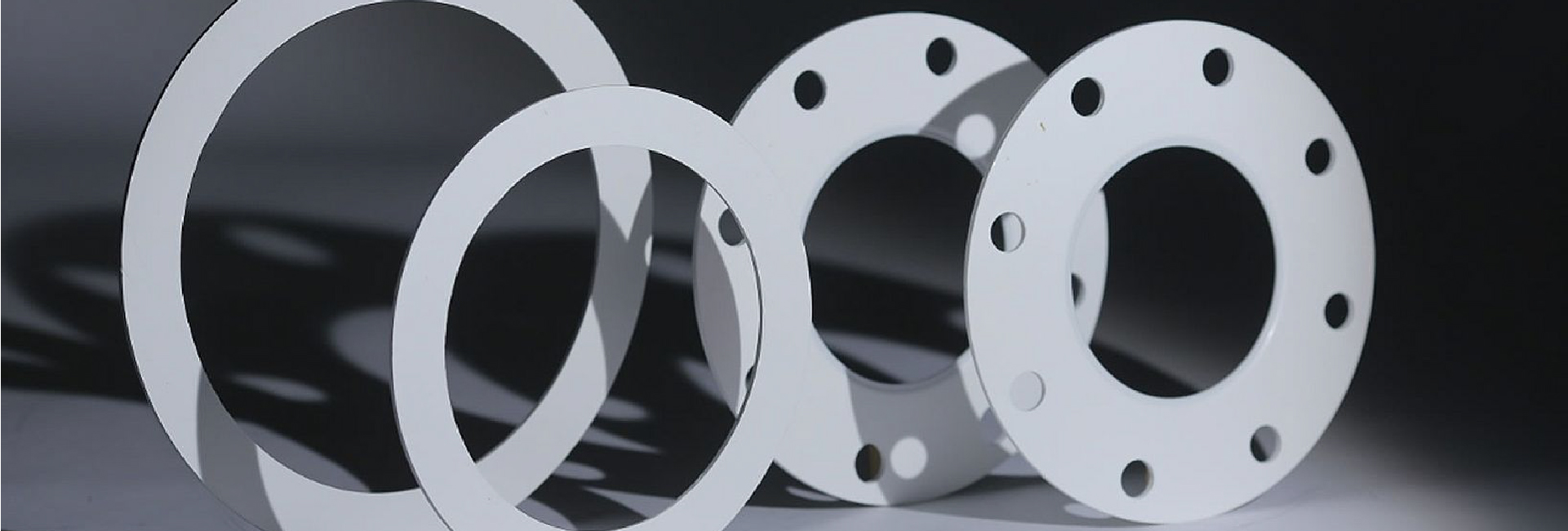
For rubber gaskets and sealing strips, EPDM is the standard choice for outdoor and weather-exposed seals, while nitrile suits oil and fuel environments. Neoprene sits between the two for general industrial use, and silicone takes over where temperatures run beyond what EPDM can handle. Match the rubber to the operating temperature first, then to chemical exposure, then to the profile. Hardness and dimensions follow once the material is confirmed.
iFoam cuts gaskets and sealing strip to size from sheet and roll at its Cape Town and Durban branches, and has supplied South African industry since 1997.
Why Material Selection Matters
A gasket only works while it keeps pushing back against the surfaces it seals. Choose the wrong rubber, or the wrong hardness for the load, and that sealing force fades in a predictable way.
The main failure is compression set: the permanent flattening a gasket keeps after sustained compression. Once the rubber cannot spring back to its original thickness, it loses sealing force and the joint leaks. Other common failures include chemical attack (mineral oils quickly destroy natural rubber), UV and ozone cracking outdoors, and breakdown when the seal runs hotter than its rubber can handle.
The cost is out of all proportion to the part. A wrongly specified gasket can fail within weeks, while a correctly specified one can last for years in the same position.
iFoam makes gaskets and seals from neoprene, EPDM, sponge rubber, closed-cell foam and cork, cut to your drawing or dimensions. See the foam density chart when specifying foam-based seals.
The Main Rubber Compounds for Gaskets and Seals
Choosing the right rubber is the single most important decision in the specification. Here is how each of the main compounds performs.
EPDM (Ethylene Propylene Diene Monomer)
EPDM is the leading rubber for outdoor and construction seals. It resists ozone, UV and weathering very well, which makes it the standard choice for window seals, door weatherstrips, roofing joints, hatch seals and steam gaskets.
EPDM is comfortable up to around 120°C, and higher in steam. It handles hot water, steam and dilute acids and alkalis well. It is not suitable for petroleum oils, fuels or aromatic solvents, and using EPDM where fuel is present is a common and costly mistake.
Neoprene (CR, Chloroprene Rubber)
Neoprene is the general-purpose industrial rubber. It offers moderate oil resistance, good abrasion resistance and useful ozone and flame resistance, which suits it to a wide range of industrial gaskets, pump seals, marine applications and refrigeration seals.
Neoprene works reliably between roughly -40°C and around 100°C. Its oil resistance is fine for occasional contact but not for immersion in petroleum fluids; nitrile is the right choice there. iFoam’s neoprene sponge suits lower-compression enclosure seals and marine settings where both oil and ozone resistance are needed. For more detail, see the guide to what neoprene is and how it is graded.
Nitrile (NBR, Nitrile Butadiene Rubber)
Nitrile is the default rubber wherever seals meet petroleum-based fluids. Its resistance to mineral oils, hydraulic fluids, greases and fuels is the highest of the common rubbers. Typical uses include fuel line gaskets, hydraulic seals, oil-resistant O-rings and engine gaskets.
Nitrile is not suited to ozone exposure, ketones, strong acids or polar solvents, so outdoor installations should use EPDM or neoprene instead. The acrylonitrile content of the compound affects its oil resistance and cold flexibility: more acrylonitrile improves oil resistance but reduces performance in the cold.
Silicone (VMQ)
Silicone handles temperature extremes that no other common rubber can match, and it is the usual choice once a seal runs hotter than EPDM can take. It is used for oven door seals, lighting seals, electrical connector seals and food-processing gaskets where both heat resistance and food-grade compliance matter. It also insulates electrically.
The trade-off is strength. Silicone has low tensile strength and poor abrasion resistance, so it is not suited to moving seals under high pressure or heavy wear.
Natural Rubber (NR)
Natural rubber is highly elastic and performs well under movement, which suits it to vibration mounts, resilient pads, moving seals and water seals. It degrades under UV and ozone, has a low temperature ceiling and has no resistance to petroleum oils or fuels. For outdoor or oil-contact jobs, a synthetic rubber is the right choice. For a comparison of foam and solid seals, see the open-cell vs closed-cell foam guide.
Rubber Compound Selection Table
| Compound | Heat Resistance | Oil and Fuel Resistance | Ozone and UV Resistance | Chemical Resistance | Typical Application |
|---|---|---|---|---|---|
| EPDM | Up to around 120°C, higher in steam | Poor | Excellent | Good (water, dilute acids) | Window seals, weatherstrips, steam gaskets |
| Neoprene (CR) | Roughly -40°C to around 100°C | Moderate | Good | Moderate | General industrial, marine, refrigeration |
| Nitrile (NBR) | Moderate | Excellent | Poor | Good (oils, fuels) | Hydraulic, fuel and oil seals |
| Silicone (VMQ) | Highest of the group | Poor | Excellent | Moderate | High-heat, food-grade, electrical |
| Natural rubber (NR) | Lowest of the group | Poor | Poor | Moderate | Vibration, moving parts, water |
Use the table as a three-step filter. Start with operating temperature: if the seal runs hotter than EPDM can handle, the field narrows to silicone before chemicals are even considered. Apply chemical exposure next: oil and fuel point to nitrile, outdoor weathering points to EPDM or neoprene. Apply mechanical needs last: heavy movement favours natural rubber or neoprene over silicone.
Matching the rubber to the chemical exposure before choosing hardness avoids most early gasket failures.
Sealing Strip Profiles Explained
The rubber decides if a seal survives its environment. The profile decides how it compresses and where it sits.
P-profile. A hollow round head on a flat mounting leg. The hollow section squashes progressively as a door or lid closes, which suits cabinet seals, access panels and light-duty doors.
D-profile. A solid or hollow D-shaped section. The thicker wall resists more compression, which suits industrial enclosures, vehicle doors and hatches where the closing force is high.
E-profile. A winged section that grips inside a channel, reducing the need for adhesive. Common in window frames and panel joints.
T-profile. A T-shaped section that pushes into a slot and locks mechanically. Used on heavy panel systems where an adhesive-backed profile would not hold securely.
Flat strip. Sheet material cut to a set thickness and width. This is the general-purpose format for cut gaskets, packing strips and face seals, and it is what iFoam cuts to order. Ordering needs thickness and width in millimetres and the length in metres, or the sheet size.
Foam tape. Open-cell or closed-cell foam with a pressure-sensitive adhesive backing. It seals against dust and draughts where compression is very light, but it is not a primary seal against water or chemicals.
Custom-Cut Gaskets vs Standard Profiles
Off-the-shelf extruded profiles cover many sealing jobs. When the groove is an unusual size, the shape is complex or the thickness tolerance is tight, a custom-cut gasket is the better answer.
Custom cutting means producing the gasket shape from sheet stock, working from a drawing, CAD file or physical template. The result fits the exact shape of the mating surfaces, rather than an approximation squeezed into place.
iFoam converts rubber seals and sealing strip from sheet and roll rather than stocking moulded profiles, so the seal is cut to your dimensions instead of you working around a standard size.
Custom cutting beats standard profiles in four situations. These are groove sizes that no standard profile matches, shapes with features on more than one face, tight thickness tolerances, and large repeat orders where a dedicated cutting set-up brings the unit cost down.
Two rubbers can share the same site. A food plant might run EPDM gaskets on its steam pipework because of EPDM’s steam and hot-water resistance, and neoprene on pumps exposed to cleaning chemicals and ozone. Each rubber is matched to its own job.
Key Specifications to State When Ordering
Giving complete details at the first enquiry saves back-and-forth and reduces the risk of the wrong seal arriving.
- Rubber compound: EPDM, neoprene (CR), nitrile (NBR), silicone (VMQ) or natural rubber (NR).
- Profile type: P, D, E, T, flat strip, foam tape or custom-cut from sheet.
- Hardness: softer grades for low-compression jobs, harder grades for high-pressure sealing.
- Thickness: in millimetres.
- Width: in millimetres, or the full cross-section for a profiled seal.
- Operating temperature: the lowest and highest the seal will see, in °C.
- Chemical or fluid exposure: name the actual substance (for example a specific hydraulic oil or a bleach solution), not just “oil” or “chemicals”.
- Quantity: length in metres for strip, or quantity and drawing reference for cut shapes.
Key principle: vague chemical descriptions are the most common cause of the wrong seal being supplied. “Oil” can mean mineral hydraulic oil, vegetable cooking oil or synthetic compressor oil, and each behaves differently against rubber.
Key Terms Explained
Compression set: The permanent flattening a rubber seal keeps after sustained compression, given as a percentage of the original squeeze and tested to ASTM D395. A low value means the rubber recovers well and keeps sealing over time.
Shore A hardness: A standard measure of how well rubber resists indentation, tested with a durometer to ASTM D2240. Lower numbers are softer; higher numbers are firmer.
EPDM (ethylene propylene diene monomer): A synthetic rubber with outstanding ozone, UV and weather resistance. The standard rubber for outdoor and construction seals.
NBR (nitrile butadiene rubber): A synthetic rubber with high resistance to petroleum oils, fuels and hydraulic fluids. The standard rubber for oil-contact seals.
Vulcanised rubber: Rubber that has been cross-linked with heat and sulphur (or peroxide for some synthetics), turning the raw polymer into a durable elastic solid. All commercial gasket rubbers are vulcanised.
PSA (pressure-sensitive adhesive): An adhesive backing on foam tape and some strips that bonds under hand pressure, with no heat or solvent needed.
Resources
- ASTM D395, Standard Test Methods for Rubber Property: Compression Set. ASTM International.
- ASTM D2000, Standard Classification System for Rubber Products in Automotive Applications. ASTM International.
- ASTM D2240, Standard Test Method for Rubber Property: Durometer Hardness. ASTM International.
- ISO 1817, Rubber, vulcanised or thermoplastic: determination of the effect of liquids. International Organization for Standardization.
- iFoam, gaskets and sealing strip.
- iFoam, rubber seals and sealing strip.
- iFoam, EPDM rubber.
- iFoam, open-cell vs closed-cell foam guide.
Frequently Asked Questions
What is compression set and why does it matter for gaskets?
Compression set is the permanent flattening a rubber gasket keeps after sustained compression, measured under ASTM D395. It matters because a gasket with high compression set loses the spring-back it needs to keep sealing. The joint gradually loosens and eventually leaks, even when the bolts are correctly tightened.
Can I use EPDM gaskets outdoors in South Africa?
Yes. EPDM is the preferred rubber for outdoor seals. Its resistance to ozone, UV and weathering is among the best of the common rubbers, which suits it to the strong sun inland and the coastal conditions in Durban and Cape Town. Keep it away from oils and fuels, which attack it.
What is the difference between P-profile and D-profile sealing strips?
A P-profile has a hollow round head on a flat leg and compresses progressively under moderate closing force, which suits cabinet doors and access panels. A D-profile has a D-shaped section with a thicker wall. It handles higher compression and is used on industrial enclosures, vehicle doors and hatches where more force is applied on closing.
Can neoprene gaskets be used outdoors?
Yes. Neoprene has good ozone and UV resistance and suits general outdoor industrial use. It is not quite as weather resistant as EPDM, but it adds moderate oil resistance. In marine settings, where both weather and occasional oil or fuel contact are likely, neoprene is often the practical choice.
Can iFoam cut gaskets to my drawing?
Yes. iFoam cuts gaskets and sealing strip from sheet and roll to a drawing, template or set of dimensions at its Cape Town and Durban branches. The shape, thickness, material, quantity and what the seal will be exposed to are all needed to cut it correctly.
What is Shore A hardness for gaskets?
Shore A hardness is a standard measure of how well rubber resists indentation, tested with a durometer under ASTM D2240. A low reading is soft and compressible; a high reading is firm and carries more load. Softer grades seal against uneven surfaces at low bolt load, while harder grades hold their shape under sustained pressure.
How long do rubber gaskets last?
Service life depends on the rubber, the environment, the compression load and how often the temperature cycles. A correctly specified EPDM gasket outdoors, or a nitrile gasket working within its limits in a hydraulic system, can last for many years. A wrongly specified gasket in an aggressive environment can fail within weeks.
What is the difference between neoprene and EPDM for gaskets?
EPDM has better ozone and UV resistance and is the standard outdoor rubber. Neoprene adds moderate oil resistance to reasonable weather resistance, so it copes better in mixed conditions. Neither is suitable for immersion in petroleum oil; nitrile is the right rubber for that. Choose EPDM for weather-only exposure and neoprene where some oil contact is also likely.
What rubber compound is best for high-temperature gaskets?
Silicone is the right choice once a seal runs hotter than EPDM can take, which is beyond roughly 120°C outside steam service. Neoprene, nitrile and natural rubber all have lower ceilings and should not be used for sustained high-temperature service.
What is the difference between a rubber gasket and a foam seal?
A rubber gasket is a solid or dense part that seals under mechanical compression at a joint. A foam seal is a cellular material that compresses under very light load and mainly keeps out dust and draughts. Foam seals, including closed-cell foam tape, are not a primary barrier against water or chemicals. Use solid rubber for sealing duty and foam for exclusion duty.
How do I specify a custom gasket?
Give the rubber type, thickness and width (or a cross-section drawing), hardness, the lowest and highest operating temperatures, the specific chemical or fluid it will touch, and the quantity needed. For complex shapes, supply a dimensioned drawing or CAD file.
Is nitrile rubber the same as NBR?
Yes. NBR is the technical name for nitrile butadiene rubber, the same material usually called nitrile. The abbreviation appears on data sheets, in ASTM D2000 classifications and in supplier documents. NBR, nitrile and Buna-N all refer to the same family of rubber.
Final Thoughts
Choose the rubber first, using operating temperature and chemical exposure as the two main filters. Choose the profile second, matching its shape to the groove and the compression needed. Then specify hardness, thickness and width. Applied consistently, that order avoids most early gasket failures.
iFoam has supplied South African industry with foam and rubber from its Durban and Cape Town branches since 1997, cutting rubber gaskets and sealing strip to order. Browse the range of gaskets and sealing strip, or contact iFoam with your drawing and specification for a quote.