
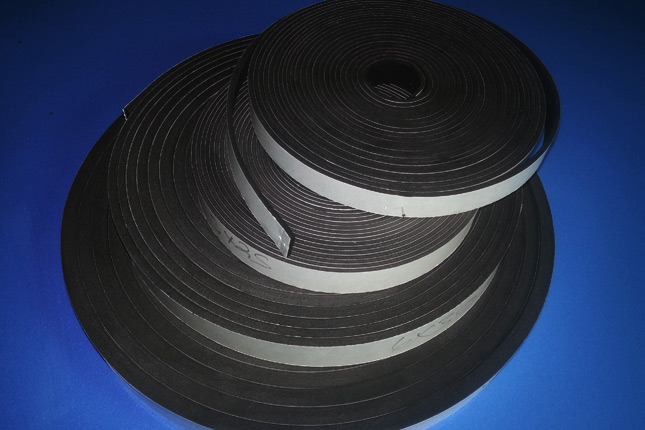
Neoprene is a synthetic rubber made by polymerising chloroprene (2-chloro-1,3-butadiene), and is designated CR rubber under ISO 1629. It resists oils, ozone, weathering and a wide temperature range, roughly -40°C to around +100°C. That combination makes it one of the most widely used rubbers for gaskets, seals, pipe insulation and wetsuits.
iFoam supplies neoprene rubber sheet and neoprene sponge from its Cape Town and Durban branches, cut to size and converted on its own floors.
The Chemistry Behind Neoprene
Neoprene is the trade name for polychloroprene, a synthetic rubber made by polymerising chloroprene. The chlorine atom on the polymer backbone is what sets neoprene apart from natural rubber and gives it better resistance to oils, ozone and heat.
Under ISO 1629, polychloroprene is designated CR rubber, placing it in the chloroprene rubber family. That designation gives a precise, internationally recognised reference when specifying materials across supply chains and engineering documents.
Neoprene was one of the first synthetic rubbers developed and is still in wide industrial use today. That staying power reflects a property balance that no single cheaper alternative fully matches.
The chloroprene base gives a balance of flexibility, chemical resistance and heat stability that natural rubber, SBR and EPDM each only partly achieve. This is why CR rubber is still specified in marine engineering, building services and many sectors in between.
Myth: Neoprene is just another name for natural rubber.
Reality: Neoprene is fully synthetic. Natural rubber comes from latex and breaks down when exposed to oils, ozone and moderate heat. Neoprene resists all three, which is why engineers choose CR rubber over natural rubber for outdoor, chemical or higher-temperature environments.
Key Physical Properties of Neoprene
Temperature Resistance
Neoprene works reliably between roughly -40°C and around +100°C, with short excursions higher. At the low end it stays flexible where natural rubber and SBR stiffen. At the high end it outlasts natural rubber in sustained heat, but it does not reach the higher ceiling of silicone.
Key principle: neoprene covers most industrial sealing in South African conditions. If an application runs hotter, a silicone grade is the usual alternative.
Where silicone’s higher cost is not justified but natural rubber cannot take the heat, neoprene sits in a practical middle ground.
Chemical Resistance
Neoprene resists aliphatic hydrocarbons, refrigerants, dilute acids and alkalis well. It copes with oils and fuels better than natural rubber. It is not, however, a match for nitrile rubber (NBR) in aggressive oil environments, or for EPDM rubber with strong acids and oxidising chemicals.
Neoprene is a poor match for aromatic solvents such as toluene and xylene, ketones and strong oxidising acids. Always check chemical compatibility against the actual media before choosing neoprene for a seal or containment job.
UV and Ozone Resistance
Neoprene resists ozone and UV far better than natural rubber and SBR. Unprotected natural rubber cracks within months of constant outdoor exposure. Neoprene holds up, which makes it suitable for marine seals, construction expansion joints and transport weatherstripping where outdoor exposure is unavoidable and seals must last for years.
Flexibility and Elasticity
Neoprene stretches well before breaking and recovers its shape after it is released. It is made in a range of hardness grades, with softer grades that conform to a surface and firmer grades that carry load, so the grade can be matched to the job.
Medium-hardness grades also have good compression set resistance, which matters for gaskets that must keep sealing under long-term bolt pressure.
Neoprene Grades and Forms
Solid Neoprene Rubber Sheet
Solid neoprene sheet is dense all the way through, with no cell structure. It is the right form where load bearing, stability under compression or direct surface contact is needed. Typical uses include flange gaskets, anti-vibration mounts, wear strips and isolation pads.
A choice of hardness grades lets engineers match stiffness to the load. Harder grades resist creep under sustained compression; softer grades conform to small irregularities in mating flanges.
Closed-Cell Sponge Neoprene
Closed-cell sponge neoprene contains sealed, gas-filled cells throughout. Because the cells are sealed, the material does not absorb or pass water. That is the deciding advantage for marine sealing, HVAC duct sealing and outdoor weatherstripping.
It compresses easily, conforms to uneven surfaces and recovers its shape when released. It also insulates well, which is why it is widely used for chilled-water and refrigeration pipe lagging in building services.
iFoam supplies closed-cell sponge neoprene in Cape Town and in Durban, in sheet, strip and custom-cut forms. For a full comparison of cell structures, see the guide to open-cell vs closed-cell foam.
Open-Cell Neoprene
Open-cell neoprene has connected cells that let air and moisture pass through. It is softer and more compressible than closed-cell and will absorb liquids. This structure suits acoustic absorption, filter backing and padding, where breathability or absorption is useful rather than a drawback.
Fabric-Lined Neoprene
Fabric-lined neoprene bonds the rubber to a woven or knitted fabric on one or both sides. The fabric adds stability, tear resistance and a defined surface. Neoprene fabric in this form is the basis of wetsuits, protective covers, compression supports and industrial gaskets that need a fabric backing for handling or bonding.
Industrial and Commercial Uses of Neoprene
Gaskets and Seals
Neoprene gaskets are in constant use across plumbing, HVAC, marine and industrial pipelines. The material suits water, low-pressure steam and a wide range of chemicals within its compatibility range. Gaskets are cut from solid neoprene sheet to match specific flange dimensions, bolt patterns and compression requirements.
iFoam makes custom gaskets and sealing strip cut to drawing from neoprene sheet, to the dimensions the job needs.
Vibration Dampening
Neoprene’s elasticity and natural damping make it good at absorbing vibration and stopping it travelling into supporting structures. Anti-vibration mounts, machine isolation pads, generator bases and compressor feet are common uses, wherever the load, chemical exposure and vibration fall within neoprene’s range.
Pipe Insulation and Lagging
Closed-cell sponge neoprene is a standard insulation for refrigeration pipework, chilled-water circuits and building services where both thermal performance and moisture resistance are needed. The sealed cells stop moisture getting in and degrading the insulation over time. Commercial refrigeration, cold rooms and building mechanical services are the main sectors.
Protective Padding and Impact Absorption
Neoprene sheet provides protective lining for cases, tool rolls, equipment housings and transit packaging where cushioning and chemical resistance are both needed. Custom-cut packing inserts and acoustic linings in enclosures are further uses.
Consumer Uses of Neoprene
Consumer products use the same polychloroprene chemistry as industrial grades. The differences lie in thickness, hardness and finish rather than the base material.
Wetsuits are the best-known example. Closed-cell sponge neoprene traps a thin layer of water against the skin; body heat warms that layer and keeps the wearer insulated in cold water. Wetsuit neoprene is usually fabric-lined on both sides for durability and stretch.
Laptop sleeves and tablet cases use neoprene for its padding, water resistance and flexibility. Knee and elbow supports use fabric-lined neoprene for compression, warmth and ease of movement.
The same properties that keep surfers warm make neoprene just as effective at sealing HVAC ducts, gaskets and pipework against heat and moisture loss in industry.
How to Choose the Right Neoprene Grade
The first decision is cell structure. Solid sheet is right for load bearing and sealing under bolt pressure. Closed-cell sponge is right for immersion, moisture exposure or insulation. Open-cell grades suit acoustic absorption and filter backings. Fabric-lined grades suit jobs that need stability, tear resistance or bonding to fabric.
Hardness follows from the load and how well the material must conform. Softer grades conform to surface irregularities and need less bolt torque to seal. Harder grades resist extrusion under high compression and give more stiffness in mounts.
Thickness depends on the sealing gap, the insulation needed or the vibration isolation target. Thicker grades insulate better and absorb more vibration; thinner grades suit tight spaces.
Check the chemical media against neoprene’s compatibility. For refrigerants, dilute acids, water and oils, neoprene is generally suitable. For aromatic solvents or strong oxidisers, consider other rubbers.
Confirm the operating temperature against the grade. For jobs that run hotter than neoprene can handle, silicone or PTFE-lined materials are the usual alternatives.
For guidance on choosing material by density, see the foam density chart. iFoam supplies custom-cut neoprene to drawing from both its Durban and Cape Town branches.
Key Terms Explained
Polychloroprene (CR rubber): The chemical name and ISO 1629 designation for neoprene. CR stands for chloroprene rubber, the family of rubbers made from polymerised chloroprene.
Closed-cell neoprene: A cellular neoprene with sealed, gas-filled cells. It does not absorb water and provides thermal insulation.
Open-cell neoprene: A cellular neoprene with connected cells that let air and moisture pass through. Softer and more compressible than closed-cell; suited to acoustic and filter uses.
Shore A hardness: A standard measure of how well a rubber resists surface indentation, using the Shore A durometer. Higher values mean a harder, stiffer material.
Elongation at break: How far a material stretches, as a percentage of its length, before it breaks under tension. Higher elongation means greater stretch and flexibility.
Compression set: The permanent deformation left in a rubber after sustained compression is released. Lower values mean better recovery, which matters for long-term sealing.
Resources
- International Organisation for Standardisation, ISO 1629: Rubber and latices, nomenclature (CR designation for polychloroprene).
- iFoam, neoprene rubber sheets.
- iFoam, neoprene sponge in Cape Town.
- iFoam, gaskets and sealing strip.
- iFoam, open-cell vs closed-cell foam guide.
- iFoam, foam density chart.
Frequently Asked Questions
What is neoprene made from?
Neoprene is made by polymerising chloroprene (2-chloro-1,3-butadiene), a chemical made from petrochemical feedstocks. The process produces polychloroprene, designated CR rubber under ISO 1629. Curing agents such as metal oxides are added during compounding to cross-link the polymer chains and develop the final mechanical properties.
Is neoprene waterproof?
Solid neoprene and closed-cell sponge neoprene are both effectively waterproof. Solid sheet has no voids for water to pass through, and closed-cell sponge has sealed cells that do not absorb or pass water. Open-cell neoprene is not waterproof, because its connected cells absorb liquid. So the cell structure you choose matters for immersion and outdoor sealing.
What is the difference between neoprene and natural rubber?
Natural rubber comes from the latex of the rubber tree and is a natural polymer. Neoprene is fully synthetic polychloroprene. Natural rubber breaks down with oil exposure, ozone, UV and sustained heat. Neoprene resists all four, so it is the better choice wherever outdoor exposure, oil contact or higher temperatures are part of the job.
What is CR rubber?
CR rubber is the ISO 1629 designation for polychloroprene, the chemical family that neoprene belongs to. CR stands for chloroprene rubber. The designation is used in engineering specifications, data sheets and supply documents to identify the rubber without using a trade name. Neoprene is the best-known trade name in the CR family.
What is the difference between closed-cell and open-cell neoprene?
Closed-cell neoprene has sealed, gas-filled cells that stop water absorption and provide insulation. It is firmer, recovers after compression and is the standard choice for pipe insulation, marine sealing and HVAC. Open-cell neoprene has connected cells that let air and moisture through. It is softer and suits acoustic absorption, filter backing and cushioning.
What is neoprene fabric used for?
Neoprene fabric is neoprene sheet bonded to a woven or knitted fabric on one or both sides, which makes it more stable, harder to tear and easier to bond. Common uses include wetsuits, diving gear, joint supports, protective covers and industrial gaskets that need a fabric backing for installation or bonding.
What temperature can neoprene handle?
Neoprene works reliably between roughly -40°C and around +100°C, with short excursions higher. At low temperatures it stays flexible where natural rubber and SBR stiffen. At higher temperatures it outperforms natural rubber but does not match silicone. For jobs that run hotter, a silicone grade is the usual alternative.
What thickness of neoprene do I need?
It depends on the job. For gaskets and seals, thickness is set by the flange gap, the compression needed and the sealing pressure. For pipe insulation, it depends on the insulation value and surface temperature required. For vibration pads, it relates to the isolation target for the equipment. iFoam supplies custom-cut neoprene in a range of thicknesses to match drawings and specifications.
How does neoprene compare to EPDM for outdoor sealing?
Both resist ozone and UV well, so both suit outdoor sealing. EPDM handles higher temperatures and resists water and steam better. Neoprene resists oil and fuel better than EPDM, so it is preferred where hydrocarbons are likely. Where the only medium is water or steam, EPDM is often chosen; where oil, refrigerants or mixed chemicals are present outdoors, neoprene is the better fit.
What are neoprene gaskets used for?
Neoprene gaskets create pressure-tight and fluid-tight joints in flanged connections across plumbing, HVAC, marine and industrial pipelines. They suit water, low-pressure steam, refrigerants, dilute acids and many oils. Gaskets are cut from solid neoprene sheet to match the flange bore, outside diameter and bolt-hole pattern.
Is neoprene safe to use in food or drink applications?
Standard industrial neoprene grades are not certified for direct food contact. Food and drink sealing usually calls for specifically compounded, certified materials, such as food-grade EPDM, silicone or nitrile. If a seal or gasket will touch potable water, food or beverages, the material must carry the relevant food-contact certification. Check the grade data sheet and local regulations first.
Where can I buy neoprene rubber in South Africa?
iFoam supplies neoprene sheet, sponge and custom-cut parts from its branches in Cape Town and Durban. Closed-cell sponge neoprene is available in a range of thicknesses, and gaskets, sealing strip and fabricated parts are cut to specification. iFoam has supplied South African industry since 1997.
Final Thoughts
Neoprene remains a benchmark synthetic rubber because its mix of temperature range, oil resistance, ozone resistance and flexibility is not matched by any single cheaper alternative. Choosing the right grade, cell structure and hardness for the conditions decides if that performance shows up in practice.
iFoam has supplied South African industry since 1997 from Cape Town and Durban, cutting neoprene to specification. Browse the neoprene rubber sheet range, or send a drawing for custom neoprene gaskets and sealing strip.