
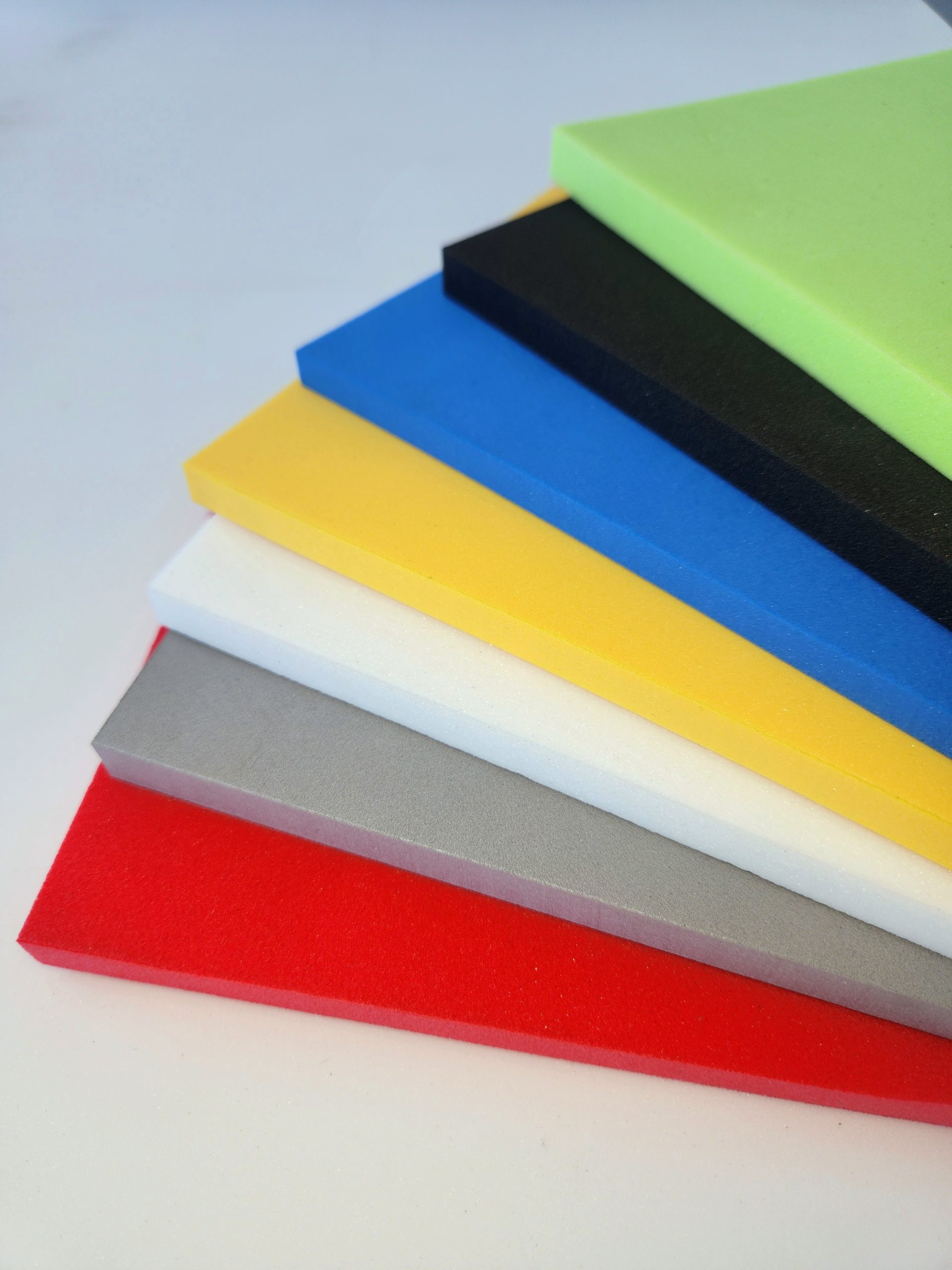
Residential seating typically uses foam rated 30 to 35 kg/m³. Commercial seating requires a minimum of 38 to 42 kg/m³. Healthcare and transport applications call for 45 kg/m³ or higher. The right density depends on how many people will use the foam, how often, and for how long. Selecting the wrong density shortens product lifespan and increases replacement costs.
What Foam Density Actually Means (and Where to Find the Full Explanation)
Foam density is the mass of foam per unit of volume, expressed in kilograms per cubic metre (kg/m³). It is a structural property, not a comfort rating. For a complete breakdown of how kg/m³, ILD, and compression set interact, refer to our foam density chart and metrics explanation, then return here to apply those numbers to your specific application.
Choosing Foam Density by Application
The appropriate foam density varies significantly by end use. A figure that performs well in residential seating will fail prematurely in a commercial waiting room, and an industrial-grade foam is unnecessary, and more costly, for a domestic bedroom cushion.
Seating and Upholstery (Residential)
The standard density range for residential upholstery foam is 30 to 35 kg/m³. At 30 kg/m³, foam meets the baseline requirement for occasional seating such as occasional chairs and decorative cushions. At 35 kg/m³, the foam tolerates daily use across a typical household and maintains its recovery under repeated compression.
Firmness is specified separately as an ILD (Indentation Load Deflection) value and does not determine density. A 32 kg/m³ foam can be produced in soft, medium, or firm ILD ratings depending on the formulation. For a family sofa used daily, specify both a density of at least 32 kg/m³ and a medium ILD rating to balance comfort and support.
At the lower end of this range (30 to 32 kg/m³) you can expect a residential seat to maintain acceptable support for three to five years under daily use before noticeable compression set occurs. At 34 to 35 kg/m³, that lifespan extends meaningfully.
iFoam offers a cut-to-size service, which removes the need for upholsterers and DIY buyers to work with standard sheet formats. Specify your seat dimensions and the required density grade when ordering.
Commercial and High-Traffic Seating
Commercial seating requires a minimum density of 38 kg/m³, with 42 kg/m³ or higher appropriate for environments where the seat is occupied by multiple users across long daily operating periods.
Applications in this category include hotel lobbies, restaurant chairs, office task seating, cinema seats, and public transport upholstery. The distinguishing factor is not simply the weight of individual users; it is the cumulative compression load and the frequency with which the foam must recover between uses.
Foam that recovers slowly, or that has begun to take a permanent compression set, creates an uneven seating surface. In commercial environments this directly affects patron comfort and brand perception. The cost of replacing low-density foam in a 50-seat restaurant, including labour and temporary closure, typically exceeds the premium paid for a higher-density foam at the time of manufacture. Specifying correctly upfront is the more economical decision.
Replacement economics matter: a 10 to 15% premium on foam density at point of manufacture routinely eliminates one full replacement cycle over a 10-year commercial asset life.
Mattresses and Sleep Surfaces
Mattress foam construction spans a wide density range because modern mattresses are frequently zoned: softer, lower-density layers on the comfort surface and firmer, higher-density layers in the support core.
The soft comfort layer typically uses foam rated 25 to 38 kg/m³ with a low to medium ILD. The firm support core runs from 30 to 45 kg/m³ with a medium to high ILD. For buyers seeking a single-layer mattress foam, 30 kg/m³ is a reasonable minimum for acceptable sleep surface quality; 35 kg/m³ and above represents a measurable improvement in durability and support consistency over time.
In our experience supplying mattress manufacturers, the most common failure point in budget sleep products is not the outer fabric but the core foam dropping below 28 kg/m³. That is where you start to see body impressions forming within 18 months.
Industrial Foam Supplier
The mattress sector in South Africa uses foam across the full range described above. This guide treats the topic at a trade level and does not recommend specific brands or retail products.
Packaging, Protection and Industrial Cushioning
Foam used for protective packaging divides into two functional categories: single-use transit inserts and reusable protective cases for instruments, tools, or industrial equipment.
Single-use packaging inserts tolerate lower-density foam because the material absorbs a single impact event and is then discarded. Shape retention over repeated use is not a requirement. For reusable inserts, such as those cut for instrument cases, camera equipment, or precision components, higher density foam is necessary to maintain the formed cavity shape across hundreds of insertion and removal cycles.
For guidance on choosing between polyethylene (PE) foam and EVA foam for packaging applications, including how density affects performance in each material type, refer to iFoam’s PE vs EVA foam selection guide.
iFoam has supplied industrial and commercial buyers since 1997. Protective packaging and fabrication work for transit and storage applications form part of its core trade offering alongside upholstery and mattress foam. For custom-cut packaging inserts, visit iFoam’s packaging inserts page.
Kneeling, Play and Anti-Fatigue Matting
Foam used for floor-level applications such as gymnastics mats, children’s play area surfaces, workshop anti-fatigue matting, and garden kneeling pads typically requires a density of 30 to 38 kg/m³.
At the lower end (30 to 32 kg/m³), the foam provides adequate cushioning for occasional kneeling or light-use play surfaces. At 35 to 38 kg/m³, the foam resists permanent compression set in environments where the surface is loaded regularly or where users are standing for extended periods, as in workshop or kitchen anti-fatigue mats.
The comfort versus durability trade-off in matting applications is managed through ILD, not density alone. A mat used in a commercial kitchen requires a medium ILD for fatigue reduction; a gymnastics landing mat requires a lower ILD for impact absorption. Specifying both variables produces the correct outcome.
Density vs. Firmness: Why They Are Not the Same Thing
Foam density (kg/m³) measures the mass of the foam material per unit of volume. It reflects structural quality and durability. Foam firmness is measured by ILD, or Indentation Load Deflection, which quantifies the force in Newtons required to indent the foam by 25% of its total depth using a standardised test plate.
These two properties are independent. Foam manufacturers can produce any density at a range of ILD ratings by adjusting the chemical formulation during production. This is why foam described only as “firm” or “soft” carries no meaningful technical information about its structural quality or lifespan.
The practical implication for buyers is straightforward: specify both values when ordering. State the density in kg/m³ and the ILD range required for the application.
Myth vs. reality: Many buyers assume that because foam feels firm, it must be high density. A 25 kg/m³ foam formulated with a high ILD rating will feel firm but will compress permanently and lose support faster than a 40 kg/m³ foam formulated with a low ILD, which will feel soft but hold its shape for years.
A practical example illustrates this directly. A 40 kg/m³ foam with a low ILD rating will feel soft but hold its shape for years under repeated use. A 25 kg/m³ foam with a high ILD rating will feel firm initially but will compress and lose support faster, because the underlying structure is less substantial, regardless of how the surface feels at point of sale.
Quick Reference Table
| Application | Recommended density (kg/m³) | ILD guidance | Indicative lifespan |
|---|---|---|---|
| Residential seating | 30 to 35 | Medium ILD for comfort | 3–5 years (30–32); 7–10 years (35+) |
| Commercial and high-traffic seating | 38 to 42 minimum | Medium-high ILD for durability | — |
| Mattress (soft side) | 25 to 38 | Low to medium ILD | — |
| Mattress (firm side) | 30 to 45 | Medium to high ILD | — |
| Packaging (single-use) | Lower density acceptable | Less critical | Single use |
| Packaging (reusable and industrial) | Higher density preferred | Firmer ILD for shape retention | Varies by use frequency |
| Kneeling and play matting | 30 to 38 | Medium ILD | — |
| Healthcare and transport | 45 and above | Varies by application | — |
Where to Buy High-Density Foam in South Africa
iFoam has operated as an industrial and commercial foam supplier since 1997, with branches in Durban and Cape Town. Its customer base spans upholstery manufacturers, mattress producers, packaging fabricators, and commercial fit-out contractors, as well as capable DIY buyers working on domestic seating and renovation projects.
A key operational differentiator is the cut-to-size capability. Buyers can specify exact dimensions rather than purchasing standard sheet formats and cutting to size independently. This reduces material waste and ensures the delivered foam fits the application without modification. Density and ILD grades can be specified at point of order.
To view the full foam range, including density grades and available formats, visit iFoam’s product range.
Resources
- ASTM International. “ASTM D3574 Standard Test Methods for Flexible Cellular Materials: Slab, Bonded, and Molded Urethane Foams.” Available at: https://www.astm.org/d3574-17.html
- iFoam. “Understanding Foam Density: kg/m³, ILD and What the Numbers Mean.” https://www.ifoam.co.za/foam-density-chart-understanding-the-metrics/
- iFoam. “PE vs EVA Foam: How to Choose the Right Density.” https://www.ifoam.co.za/pe-vs-eva-foam-how-to-choose-the-right-density/
Frequently Asked Questions
What kg/m³ foam do I need for a couch?
For a residential couch used daily, a density of 32 to 35 kg/m³ is the appropriate range. At 32 kg/m³, the foam supports typical household use and maintains adequate recovery between sessions. At 35 kg/m³, the seat retains its shape and support level for a longer period before compression set becomes perceptible. Foam at 30 kg/m³ is acceptable for occasional seating but will degrade faster under daily use.
Is 30 kg/m³ foam good quality?
At 30 kg/m³, foam meets the minimum threshold for residential upholstery applications. It is a functional material for bedroom chairs, occasional seating, and light domestic use. For a primary sofa used daily by multiple occupants, 32 to 35 kg/m³ is a more appropriate specification. The 30 kg/m³ grade is not suitable for commercial or high-traffic applications.
What is the difference between foam density and firmness?
Foam density (kg/m³) measures mass per unit of volume and reflects structural durability. Firmness is measured by ILD, or Indentation Load Deflection, which measures the force required to compress the foam by 25% of its depth. These two properties are set independently during manufacturing. Dense foam can be produced in soft, medium, or firm ILD grades. Specifying only firmness without density provides no information about how long the foam will last.
How long does high-density foam last in a sofa?
Foam rated 35 kg/m³ or above in a residential sofa subject to daily use typically maintains acceptable support for seven to ten years before compression set becomes noticeable. Foam at 30 to 32 kg/m³ under the same conditions may show measurable compression within three to five years. Environmental factors including UV exposure, humidity, and cleaning products also affect longevity.
Can I use high-density foam for packaging?
Yes. High-density foam is appropriate for reusable protective packaging, instrument cases, and industrial transit inserts where the foam cavity must retain its formed shape across repeated use cycles. For single-use transit packaging, lower-density foam is structurally adequate and more cost-effective. The decision point is whether the packaging will be reused. If it will, specify a higher density grade to maintain shape retention over time.
How do I know if foam is high density?
Foam density cannot be determined by feel alone. A firm-feeling foam is not necessarily high density; it may simply have a high ILD rating. Reliable methods include requesting the technical data sheet from the supplier, which should state the density in kg/m³, or physically measuring and weighing a known volume of foam to calculate the figure directly. Reputable suppliers such as iFoam provide density specifications at point of sale.
What foam density is best for a mattress?
A mattress support core of 30 to 40 kg/m³ represents the most common range for quality sleep surfaces in the South African market. The comfort layer can be softer and lower in density (25 to 35 kg/m³) because it is not load-bearing in the same structural sense. For a single-layer foam mattress, 32 to 38 kg/m³ with an appropriate ILD for the intended sleeper weight is a practical specification.
Is 25 kg/m³ foam any good?
At 25 kg/m³, foam is at the lower boundary of acceptable performance for soft mattress comfort layers and light-duty applications. It is not recommended for seat cushions, primary sofas, or any application involving repeated daily compression. The material will reach noticeable compression set within a shorter period than foam at 30 kg/m³ or above. In packaging applications where single-use performance is sufficient, 25 kg/m³ can be appropriate.
What is the most common foam density range?
The 30 to 38 kg/m³ range covers the largest proportion of residential upholstery, mattress, and light commercial applications in South Africa. This range represents a functional balance between material cost and structural durability for the majority of everyday use cases. Densities below 30 kg/m³ are typically limited to packaging or low-load applications; densities above 40 kg/m³ address commercial, healthcare, and industrial requirements.
How does foam density affect price?
Higher-density foam contains more raw material per unit of volume and therefore costs more per cubic metre than lower-density equivalents. The price differential between a 30 kg/m³ and a 40 kg/m³ foam of the same ILD grade is a direct function of material quantity. Over the asset life of the product, however, higher-density foam frequently reduces total cost by eliminating early replacement cycles. The calculation is total cost of ownership, not purchase price per unit.
Final Thoughts
Selecting the correct foam density requires specifying the application, the frequency of use, and the number of users, then matching those parameters to the appropriate kg/m³ grade and ILD rating. Density and firmness are independent specifications; both must be stated when placing an order. For trade buyers and DIY customers in South Africa, iFoam supplies cut-to-size foam across the full density range from its Durban and Cape Town locations. Contact iFoam directly or visit the product range to specify the grade your project requires.