
Unwanted noise intrusion is one of the most disruptive problems in residential and commercial spaces across South Africa, whether it is a neighbour’s music penetrating a shared wall, traffic rumble entering a bedroom, or echo undermining a home studio recording.
To soundproof a room, you need to apply four principles: mass (heavy materials that resist sound), decoupling (separating structural layers to kill vibration), damping (converting sound energy to heat), and absorption (soft materials that prevent internal echo). Sealing every air gap is the cheapest and highest-return step before any other treatment.
Key fact: doubling wall mass increases the STC rating by only 6 points. This means mass alone is a poor strategy. The most effective assemblies combine all four principles.
This guide covers the science behind those principles, a practical step-by-step process for any budget, honest guidance on what acoustic foam does and does not do, and product options available through iFoam’s South African supply network.
Soundproofing vs. Sound Absorption: Know the Difference First
The single most common mistake people make when researching noise control is treating soundproofing and acoustic treatment as the same thing. They are not. Confusing the two leads to purchases that do not solve the problem.
Soundproofing (blocking) refers to preventing sound from crossing a physical barrier: a wall, floor, or ceiling. The metric used to quantify this performance is the STC, or Sound Transmission Class, which measures how many decibels of airborne sound a partition reduces across a range of frequencies. It is a single-number rating derived from laboratory testing under ASTM E90, the standard test method for airborne sound transmission loss of building partitions. Higher STC equals better blocking.
Acoustic treatment (absorbing) refers to controlling how sound behaves inside a room once it has entered. The goal is to reduce reverberation, echo, and standing waves. The metric here is NRC, or Noise Reduction Coefficient. It measures the fraction of incident sound energy a material absorbs, on a scale from 0 (perfect reflection) to 1.0 (total absorption). Acoustic foam is primarily an absorption material.
| Soundproofing (blocking) | Acoustic treatment (absorbing) | |
|---|---|---|
| Goal | Prevent sound crossing surfaces | Reduce echo inside the room |
| Metric | STC (Sound Transmission Class) | NRC (Noise Reduction Coefficient) |
| Key materials | Mass-loaded vinyl, drywall, concrete, rubber sheeting | Acoustic foam, rockwool, fabric-wrapped panels |
| Acoustic foam role | Minimal: not a blocking material | Primary absorption material |
| Addresses | Noise entering or leaving the room | Noise behaviour within the room |
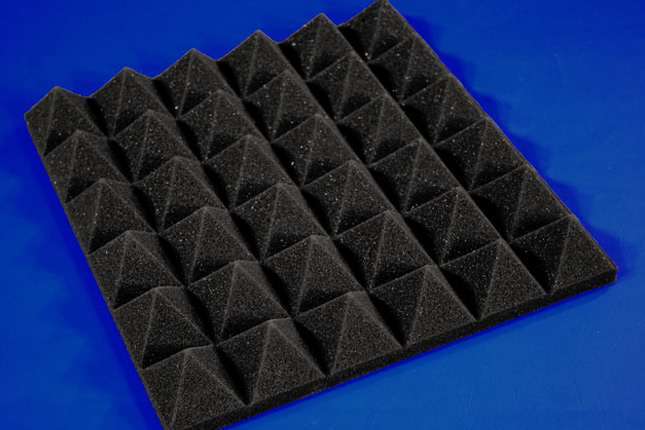
Acoustic foam does not soundproof a room. This is the most persistent myth in the noise control industry. A room lined entirely with acoustic foam will still transmit sound through its walls at effectively the same level as an untreated room. The foam absorbs energy inside the room; it does not stop energy crossing the structure.
For a detailed explanation of the distinction, see iFoam’s guide on soundproofing vs sound absorption. For the absorption layer in a complete treatment, see iFoam’s guide to acoustic foam panels: types and placement.
The Four Principles of Soundproofing
Every effective soundproofing assembly combines some or all of four physical principles. Understanding each one allows you to diagnose why a treatment is underperforming and where to invest next.
1. Mass
Heavier materials resist sound waves more effectively. A solid concrete wall blocks far more sound than a hollow plasterboard partition of the same area.
The Mass Law is the governing principle here. Doubling a material’s surface mass increases its STC by only 6 points. For example, a wall rated STC 26 becomes approximately STC 32 when its mass is doubled. This holds across most mid-frequency ranges but becomes less reliable at very low frequencies. This limited return means simply piling on more mass is inefficient beyond a point.
Mass Law in practice: doubling wall mass yields only 6 additional STC points, not a proportional improvement.
Common mass-adding materials include concrete, dense brick, mass-loaded vinyl (MLV) sheeting, multiple layers of gypsum drywall, and dense rubber sheeting. iFoam can supply dense rubber sheeting and foam-backed heavy panels that contribute mass at specific frequency ranges.
The industry rule of thumb is that a single stud-framed wall with one layer of drywall on each side performs around STC 33 to 35. Most clients are surprised how much additional mass or decoupling is required to reach STC 50 or above for a habitable noise-sensitive room.
Acoustic Consultant, commercial fit-out practice
2. Decoupling
Two surfaces connected by a rigid structure allow vibration to travel directly between them. Break that connection, and the sound loses its transmission path. This is decoupling.
The double-wall effect occurs when an air gap or resilient layer separates two independently supported wall faces. Even a small physical separation produces STC improvements that would require enormous additional mass to match.
Methods include resilient channels (hat-shaped metal profiles attached to studs before drywall is fixed), staggered stud walls (where two rows of studs share a single bottom plate but never touch each other), double stud walls with a full air gap, floating floor assemblies using rubber isolation pads or isolation clips, and decoupled ceiling systems hung on spring mounts.
Professional construction differs from DIY most significantly at this principle. A well-decoupled assembly consistently outperforms a massively loaded but rigidly connected one.
3. Damping
Damping converts sound energy (mechanical vibration in a panel) into heat, preventing the panel from re-radiating that energy as sound on the other side.
Viscoelastic compounds, sometimes called constrained layer damping compounds, are applied between two layers of drywall. The compound works by flexing under vibration and dissipating energy as low-level heat. It is most effective in the mid-frequency range and offers diminishing returns at very low bass frequencies.
4. Absorption
Soft, porous materials inside a room reduce standing waves, flutter echo, and reverberation. This is the fourth principle, and it operates independently of the blocking function.
Absorption does not block sound from leaving or entering the room on its own. It controls how sound energy that is already inside the room decays over time and whether it excites resonant modes at particular frequencies.
Materials include acoustic foam panels, rockwool and glasswool batts, fabric-wrapped rigid fibre panels, and acoustic ceiling tiles. Foam thickness determines the frequency range addressed: 25mm panels absorb high-frequency sound primarily, 50mm to 100mm panels address the mid-frequency range, and corner-mounted bass traps of 100mm or thicker target low-frequency build-up.
For a full guide to foam types and placement strategies, see iFoam’s guide to acoustic foam panel types and placement.
Step-by-Step: How to Soundproof a Room
Follow these steps in order. Each step builds on the last, and skipping earlier steps undermines later ones.
Step 1: Identify Your Noise Problem (Airborne vs. Impact)
Before spending money, determine what type of noise you are dealing with.
Airborne noise travels as sound waves through air: speech, music, television, and traffic are the primary examples. It enters through walls, windows, gaps, and any penetration in the building envelope.
Impact noise travels directly through the building structure: footsteps above, doors slamming in the frame, objects dropped on a floor above. The structure itself becomes the transmission medium.
The distinction matters because the solutions differ. Airborne noise is addressed primarily by mass and decoupling. Impact noise is addressed by decoupling and isolation at source, often including soft underlays beneath hard floor surfaces or isolation mounting for mechanical equipment.
A practical diagnostic: can you hear your neighbour’s television through the shared wall? That is airborne transmission. Can you hear footsteps from the floor above? That is impact transmission. Many real-world situations involve both.
Step 2: Seal All Air Gaps First (The Highest ROI Step)
Sound travels through air. Any gap, no matter how small, is a direct acoustic bypass around every wall treatment you apply.
Priority locations to inspect and seal:
- Underneath doors: install a door sweep or automatic door seal to close the gap between door bottom and floor.
- Around door frames: apply compressible acoustic seal or closed-cell foam tape to the frame rebate.
- Window frames: acoustic sealant applied to any crack or joint where the frame meets the wall.
- Electrical back boxes: acoustic putty pads installed behind socket and switch faceplates prevent sound transmission through hollow cavities.
- Ventilation and pipe penetrations: seal around any penetration with fire-rated acoustic mastic where appropriate.
Total cost for sealing a single room: door sweeps and sealant typically cost under R500 in South Africa. The ROI on this step exceeds any other single intervention.
Important caveat: sealing gaps alone will not achieve dramatic STC improvement in a lightweight partition wall. However, even a wall treated with expensive mass and decoupling products will underperform if obvious air paths remain unsealed.
Step 3: Add Mass to Walls and Ceiling
Once gaps are sealed, the next step is increasing the surface mass of the partition.
Options in approximate cost order:
- Additional layer of 12mm or 15mm gypsum drywall fixed directly to existing framing.
- Mass-loaded vinyl (MLV) sheeting applied to existing wall surfaces before a layer of drywall.
- Dense rubber-backed panels.
- Concrete block or double-skin brick if building from new.
The Mass Law limits returns here. Adding a single layer of 12mm gypsum to an STC 33 stud wall may bring it to approximately STC 36 to 38.
iFoam can supply dense rubber sheeting and foam-backed heavy panels suited to mass-adding applications. See the full range of iFoam acoustic and soundproofing products.
Step 4: Decouple the Structure Where Possible
The highest STC gains available in a single intervention come from separating two faces of a wall, floor, or ceiling so they can no longer vibrate as a single unit.
DIY-accessible decoupling methods include:
- Resilient channels: hat-shaped metal profiles screwed to existing studs, with drywall then fixed to the channel rather than the studs. The channel flexes under vibration rather than transmitting it rigidly.
- Acoustic isolation clips: purpose-designed clips that attach to studs and hold hat channels at a fixed standoff, with rubber or neoprene isolators built into the clip body.
- Rubber isolation pads: installed beneath a floating floor assembly or under heavy equipment.
Construction-level decoupling uses staggered or double stud walls, where two independent wall faces share only a bottom and top plate and never touch each other, creating a full air gap across the cavity.
The practical limitation: if the wall is already fully constructed, adding decoupling without opening the wall requires building an entirely new wall in front of the existing one, which costs floor space. For tenants or occupants who cannot alter the building structure, decoupling is often not achievable without significant sacrifice.
Step 5: Treat the Room Interior for Absorption
Once blocking layers are in place, control how sound behaves inside the room.
Place acoustic foam panels at first reflection points: the side wall positions where sound from a speaker or voice source reflects toward the listening position. Treat the rear wall to reduce flutter echo between the front and rear wall pair. Position bass traps in corners, where low-frequency energy concentrates.
Foam thickness selection: 25mm panels for high-frequency echo treatment; 50mm to 100mm panels for mid-frequency control; 100mm or thicker corner bass traps for low-frequency management.
For full guidance on panel types and placement geometry, see iFoam’s guide to acoustic foam panel types and placement. Cape Town buyers can find local supply through acoustic foam in Cape Town.
Step 6: Test and Measure
Once treatment is complete, verify the result against the original problem.
A free SPL (sound pressure level) meter application on a smartphone provides rough before-and-after measurements. Place the device inside the treated room and measure ambient noise levels with and without the external sound source active. Compare to measurements taken before treatment.
For studios, broadcast rooms, or commercial spaces where a specific STC performance is required for compliance or lease purposes, commission an acoustic consultant to carry out formal ASTM E90/E413 testing. This produces a verified STC figure for the partition.
The most common cause of disappointing results is a gap that was not identified in Step 2. If the treated room underperforms expectations, begin diagnostics by checking all penetrations and seals before investigating the mass or decoupling layers.
How to Soundproof a Room Cheaply in South Africa
Effective soundproofing does not require a full construction project. Understanding the cost tiers helps set realistic expectations for any budget.
- Budget Tier 1: Sealing (under R500). Door sweeps, acoustic sealant, window perimeter seals, and putty pads for electrical sockets. The highest return on investment of any tier. Address this first regardless of overall budget.
- Budget Tier 2: Adding mass (R500 to R3,000). An additional layer of drywall, heavy lined curtains, mass-loaded vinyl sheeting, or dense rubber-backed panels. Acoustic foam panels fit this tier as the absorption layer (not the blocking solution). Meaningful improvement for speech-frequency airborne noise.
- Budget Tier 3: Decoupling elements (R3,000 to R15,000). Resilient channel systems, acoustic isolation clips, rubber isolation pads for floating floor sections. Requires construction skill and, in most cases, the ability to open and reline walls. Not suitable for renters without landlord agreement.
- Budget Tier 4: Professional build (R15,000 and above). Staggered or double stud wall construction, floating floor assemblies with specified isolation mounts, professional acoustic door systems with compression seals, and full ceilings on isolation hangers. Required for home studios with amplified music, commercial recording facilities, or any application demanding STC 50 and above.
Mini case study: A Durban podcast producer converted a spare bedroom for voice recording. After lining three walls with 50mm acoustic foam (Tier 2), the echo on recordings improved markedly, but street noise from a busy road remained audible on every take. On investigation, a 4mm gap under the door and unsealed electrical sockets were identified as the primary air paths. Installing a door sweep and acoustic putty pads (Tier 1 intervention, total cost R380) reduced the street noise intrusion enough that it fell below the noise floor of the microphone at normal speaking distance. The foam panels were a valuable absorption treatment; the sealing was the blocking solution.
Myth vs. Reality. Myth: Lining a room with acoustic foam panels will stop sound from passing through the walls to neighbours. Reality: Acoustic foam is an absorption material. It reduces reverberation and echo inside the treated room. It does not meaningfully reduce the STC of the wall itself. A room lined with 50mm acoustic foam will transmit sound to adjacent spaces at essentially the same level as an untreated room. Blocking sound requires mass, decoupling, and air sealing.
Soundproofing for Specific Room Types
Home Studios and Podcasting Rooms
A home studio has two distinct acoustic objectives: preventing external noise from entering the recording environment (soundproofing), and controlling acoustic behaviour inside the room (absorption). Both are required, but they use different tools.
STC targets for home studio use vary by application. For voice-only recording in a suburban residential setting, STC 45 to 50 is typically adequate to prevent moderate neighbourhood noise from appearing on recordings at standard microphone distances. For music recording with amplified instruments or acoustic drums, STC 55 to 65 or above is typically required.
South African studios face a specific challenge that most international guides do not address: loadshedding. Diesel or petrol generators are significant broadband and low-frequency noise sources. Vibration isolation between the generator and the building slab is essential; additional wall treatment on the facade facing the generator location should be prioritised. See iFoam’s range of acoustic and soundproofing products for industrial-grade rubber sheeting suitable for generator isolation pads.
Bedrooms (Street Noise, Neighbours)
The most common residential complaint is traffic noise and neighbour noise entering through shared walls or windows.
Windows are frequently the acoustically weakest point in any room. A single-glazed window in a solid masonry wall can reduce the effective STC of that wall assembly from STC 50 or above down to STC 25 to 30 at the glass surface. Secondary glazing or double glazing provides substantial improvement to the window assembly specifically.
For shared walls, the approach is mass addition and air sealing. Full decoupling (a second wall built in front of the shared wall) is effective but costs floor space and is typically not viable in a rented property without landlord approval.
Floor-to-ceiling lined curtains at windows contribute both marginal noise reduction and meaningful echo reduction inside the bedroom, and they are reversible without structural work.
Home Offices
The primary goal for a home office is bidirectional: reducing household noise intrusion during working hours, and preventing sound from meetings and calls leaking into the rest of the property.
The door is almost always the most acoustically weak element in a residential office. A hollow-core interior door provides very low STC performance, typically STC 20 to 28. Replacing it with a solid-core door and adding a compression seal and door sweep is frequently the single most impactful structural change for a home office.
Acoustic foam panels or fabric-wrapped absorbers on walls reduce the echo that makes remote video calls sound reverberant and unprofessional. For call clarity specifically, absorption inside the room is often sufficient if the door and frame sealing are also addressed.
Industrial and Commercial Spaces
iFoam is an established industrial supplier with facilities in Durban and Cape Town. Commercial applications include machinery acoustic enclosures, plant room lining, open-plan office acoustic partitions, and recording or broadcast studio fit-outs.
Industrial soundproofing materials differ from residential grades: heavier rubber sheeting, higher-density foam (typically 80 to 120 kg/m³ for machine enclosure applications), and custom-fabricated enclosures. For enquiries on commercial or industrial acoustic requirements, see iFoam’s full range of acoustic and soundproofing products.
What Acoustic Foam Can and Cannot Do
Because acoustic foam panels are the most visible and widely marketed soundproofing product, it is worth addressing their capabilities and limitations directly.
What acoustic foam does: Acoustic foam absorbs sound energy inside the room in which it is installed. It reduces reverberation time (the duration for which sound reflects and decays in the space), suppresses flutter echo between parallel hard surfaces, and attenuates standing waves at the frequencies its thickness can address. These are real and measurable improvements. NRC values for quality open-cell acoustic foam typically range from 0.65 to 1.00 across mid and high frequencies, depending on thickness and density.
What acoustic foam does not do: Foam does not meaningfully block sound from passing through walls, floors, or ceilings. The STC contribution of acoustic foam panels on a wall surface is negligible. A room lined with acoustic foam will still transmit sound to adjacent rooms at essentially the same level as before the foam was installed. The foam does nothing to add mass, decouple the structure, or seal air paths.
Where foam fits in the treatment hierarchy: Absorption is the fourth principle. It is necessary for a complete acoustic environment (particularly for recording, broadcast, or call-quality applications), but it is effective only after mass, decoupling, and sealing have been addressed. Applying acoustic foam to a room with unsealed gaps and lightweight partition walls will improve the sound of recordings made inside the room; it will not reduce audibility in the room next door.
For blocking applications, iFoam’s range includes dense rubber sheeting and foam-backed panels with meaningful mass contribution. See the full acoustic and soundproofing product range. For absorption products and installation guidance specific to Cape Town, see acoustic foam in Cape Town.
Key Terms Explained
STC (Sound Transmission Class) — A single-number rating that measures how effectively a partition (wall, floor, or ceiling) blocks airborne sound. Derived from laboratory testing per ASTM E90 and rated per ASTM E413. Higher STC equals better blocking. STC testing does not score assemblies below 125 Hz, so it does not capture low-frequency performance accurately.
NRC (Noise Reduction Coefficient) — A single-number rating that measures how much sound energy a material absorbs. Scale from 0 (no absorption) to 1.0 (full absorption). Applies to acoustic treatment, not soundproofing.
Mass Law — The acoustic engineering principle stating that doubling a partition’s surface mass increases its STC by only 6 points. This limits the efficiency of mass-only strategies and makes decoupling the more productive investment for high-performance assemblies.
Decoupling — The physical separation of two structural layers (wall faces, floor and subfloor, ceiling and joist) so that vibration in one cannot directly excite the other. Achieved through resilient channels, isolation clips, air gaps, or spring mounts. Produces the largest STC gains of any single intervention.
Damping — The conversion of sound energy (vibration in a panel) into heat, reducing re-radiation. Applied as a viscoelastic compound between two rigid layers. Most effective in the mid-frequency range.
Airborne noise — Sound that travels through air before hitting a surface: speech, music, traffic. Primary solution: mass and decoupling in the partition.
Impact noise — Sound that enters the structure directly through physical contact: footsteps, dropped objects, mechanical vibration. Primary solution: decoupling and isolation at the point of impact.
Resilient channel — A thin, hat-shaped metal profile screwed to wall studs or ceiling joists, with drywall fixed to the channel rather than directly to the framing. The channel flexes under vibration, interrupting the rigid connection and improving STC by introducing a decoupled layer.
Flutter echo — A rapid, audible repetition of sound created when a sound wave bounces between two parallel hard surfaces. Common in untreated rooms. Eliminated by applying absorption to at least one surface of each parallel pair.
Resources
iFoam resources:
- iFoam acoustic and soundproofing products
- Acoustic foam in Cape Town
- Soundproofing vs sound absorption explained
External authoritative references:
- ASTM International. “ASTM E90: Standard Test Method for Laboratory Measurement of Airborne Sound Transmission Loss of Building Partitions and Elements.” https://www.astm.org
- Acoustical Society of America. Public resources on room acoustics and sound isolation. https://acousticalsociety.org
Frequently Asked Questions
Does acoustic foam actually soundproof a room?
No. Acoustic foam is an absorption material. It reduces echo, reverberation, and flutter echo inside the room in which it is installed. It does not block sound from passing through walls, floors, or ceilings to adjacent spaces. If you need to stop noise from entering or leaving a room, you need mass-loading materials, decoupling, and thorough air sealing. Acoustic foam is the final absorption layer in a complete treatment, not the primary blocking solution.
What is the cheapest way to soundproof a room in South Africa?
Sealing air gaps is the highest-return investment regardless of budget. A door sweep (typically R100 to R250), acoustic sealant around the window frame (R80 to R150 per tube), and acoustic putty pads behind electrical sockets can be completed for under R500 in most cases. No mass-adding or decoupling product will perform to its rated potential if air paths remain open. Begin with sealing before spending money on any wall treatment.
What STC rating do I need for a home studio?
For voice-only recording (podcasting, voiceover) in a suburban residential environment, STC 45 to 50 in the partition walls is typically sufficient to prevent moderate neighbourhood noise from appearing on recordings. For music recording with amplified instruments, guitars through amplifiers, or acoustic drums, STC 55 to 65 or above is generally required. These targets assume background noise levels typical of a South African residential suburb; properties adjacent to busy roads or industrial activity may require higher ratings.
Can I soundproof a room without removing walls?
Partially, yes. Sealing (Step 2) requires no structural work. Adding mass via a layer of drywall fixed to existing framing, or MLV sheeting adhered to the existing surface, involves surface work but not wall removal. Full decoupling, which delivers the largest STC improvements, typically requires access to the framing and is therefore not achievable in a finished room without removing at least one face of the wall. As a rental alternative, building a freestanding secondary wall in front of the shared wall achieves decoupling without touching the original structure, at the cost of floor space.
What is the difference between soundproofing and acoustic treatment?
Soundproofing blocks sound from crossing a physical barrier. The metric is STC. Materials include mass-loaded vinyl, additional drywall layers, concrete, and rubber sheeting. Acoustic treatment controls how sound behaves inside a room. The metric is NRC. Materials include acoustic foam panels, rockwool absorbers, and fabric-wrapped panels. A complete noise-controlled room requires both: blocking to prevent transmission between spaces, and absorption to manage the acoustic environment within the treated space. See iFoam’s guide on soundproofing vs sound absorption.
How do I stop noise from neighbours coming through my walls?
Begin by identifying the type of noise. Airborne noise (speech, music) requires mass and decoupling in the shared wall. Impact noise (footsteps, structural vibration) requires decoupling and, ideally, isolation at the source. For a rented property where you cannot modify the wall, your options are limited to mass-adding surface layers (a second layer of drywall, MLV sheeting) and building a freestanding decoupled wall in front of the shared wall. Both approaches reduce but rarely eliminate transmission. Sealing all gaps, including around the door and any penetrations in the shared wall, must be completed first.
What is the Mass Law in soundproofing?
The Mass Law is the acoustic engineering principle that describes the relationship between a partition’s surface mass and its ability to block airborne sound. The law states that doubling the surface mass of a partition increases its STC by approximately 6 points. For example, a stud wall with one layer of drywall on each side rated at STC 33 would reach approximately STC 39 if the mass of the assembly were doubled. The limited return per mass investment makes decoupling a more efficient strategy once basic mass levels are established.
What is STC and how is it measured?
STC stands for Sound Transmission Class. It is a single-number rating that summarises how effectively a partition blocks airborne sound across a frequency range from 125 Hz to 4,000 Hz. Measurements are taken in a laboratory under ASTM E90 conditions, with the partition installed between two reverberant rooms. The transmission loss at each test frequency is compared to a standard reference contour, and the STC value is the contour value at the point of best fit per ASTM E413. Higher STC equals better blocking. Important limitation: STC testing does not score performance below 125 Hz, so it does not capture low-frequency performance for bass-heavy music or traffic rumble.
Does soundproofing work for bass and low-frequency noise?
Low-frequency sound (bass music, traffic rumble, generator noise) is the most difficult noise type to block. The STC rating system itself does not measure performance below 125 Hz, which means a wall with a strong STC rating on paper can still transmit bass frequencies significantly. Effective low-frequency blocking requires very high mass or a wide air gap in a decoupled assembly, or both. Bass frequencies also require thick absorbers (100mm or more) to address effectively in the absorption layer. If low-frequency noise is your primary problem, consult an acoustic engineer before committing to a treatment strategy.
How do I soundproof a room from outside traffic noise?
Traffic noise is primarily airborne noise entering through windows, gaps, and lightweight wall assemblies. Begin with the window: single-glazed windows are typically the weakest point in a masonry wall assembly. Secondary glazing or full double-glazing replacement provides substantial improvement. Seal all gaps around the window frame with acoustic sealant. Install a door sweep and seal the door frame. If the wall itself is a secondary noise path (common in lightweight timber-frame construction), add a layer of drywall and MLV. Heavy lined curtains provide marginal additional reduction at the window surface and improve the acoustic quality of the room interior.
Final Thoughts
Effective soundproofing follows a clear sequence: seal every air gap first, add mass to the partition, decouple the structure where the budget and building allow, and treat the room interior with absorption as the final layer. Acoustic foam panels serve a genuine purpose in that fourth step, but they are not a substitute for the first three. For South African buyers, whether in Durban, Cape Town, or any other centre, iFoam supplies industrial and residential acoustic materials across the full treatment spectrum. For product options suited to your specific application, see the iFoam acoustic and soundproofing product range.