
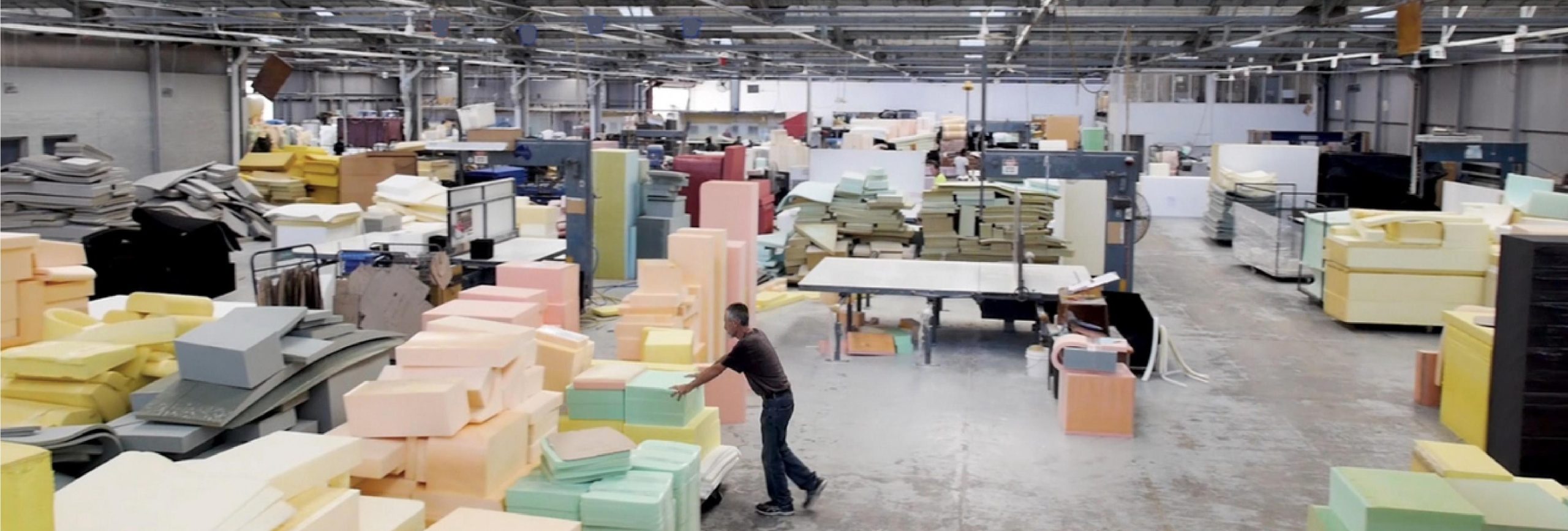
To replace sagging couch cushions, choose high-density foam for couch cushions in the region of 30 to 36 kg/m³ for the seats and 22 to 28 kg/m³ for the backs. Pair the right density with the right firmness, usually a medium to firm ILD for seats, and the new cushions will outlast the foam they replace.
iFoam has supplied foam and rubber across South Africa since 1997 and cuts upholstery foam to your exact measurements at its Cape Town and Durban branches.
Why Couch Cushions Sag (and When to Replace the Foam)
In most cases sagging couch cushions are not a fabric problem or a frame problem. The cause is the foam itself. Polyurethane upholstery foam is an open-cell material: millions of small, connected cells give it its bounce and support. Years of repeated compression break those cell walls down, and once they collapse, nothing brings the original structure back.
That is why it pays to understand density, ILD and foam grade before ordering replacement foam. Specifying the wrong grade simply repeats the failure that made the replacement necessary.
Myth: Turning or fluffing foam cushions restores them.
Reality: Flipping and rotating cushions spreads the wear more evenly and can delay replacement. It does not reverse cell collapse. A foam core that has lost its resilience will keep compressing however often it is turned. The only fix is new foam.
It is also worth separating two different problems. If the foam core crumbles, feels gritty or no longer returns to shape, the core needs replacing. If the core still feels supportive but the cushion looks flat or lumpy, the Dacron wrap (the soft polyester fibre layer around the foam) may have compressed or shifted. In that case, re-wrapping the core can restore the cushion’s shape without new foam.
How Long Should Sofa Foam Last?
Service life depends mainly on the grade of foam originally used.
Economy foam in the 18 to 22 kg/m³ range often shows permanent compression within a few years, especially in busy households. At 30 to 32 kg/m³ a daily-use seat typically keeps acceptable support for three to five years, and at 34 to 36 kg/m³ that lifespan extends meaningfully. Back cushions carry a lighter load than seats, so they usually last longer than the seat foam in the same couch.
The South African climate adds another variable. Heat and humidity, particularly in coastal cities such as Durban, speed up the breakdown of polyurethane foam. Foam in a well-ventilated room will outlast foam in a humid, poorly ventilated one.
Bottom line: a seat cushion that has gone flat within a few years was almost certainly under-specified in the first place.
Signs the Foam Needs Replacing
Replace the foam core when one or more of the following apply:
- The cushion sits noticeably lower than its original height
- The foam feels gritty or crumbles when pressed
- You can feel the springs or frame base through the cushion when seated
- The cushion does not recover its shape within 10 to 15 seconds of standing up
- The seat looks lumpy or unevenly compressed
Understanding Foam Density and ILD for Seating
Choosing foam for couch cushions comes down to two separate measures: density and ILD. They are not the same thing, and getting one right while ignoring the other produces a cushion that either wears out too soon or feels wrong. For full reference figures, see iFoam’s foam density chart.
What Is Foam Density (kg/m³)?
Density is mass per unit volume, measured in kilograms per cubic metre. A higher-density foam packs more material into each cubic metre, which means more cell walls, more resistance to compression and a longer service life.
Density does not decide how a foam feels to sit on. That is governed by ILD. Density decides durability.
Four practical tiers apply to upholstery:
- Low, 18 to 22 kg/m³. Economy grade with a short service life under daily use. Only suitable for decorative seating that is rarely used.
- Medium, 24 to 28 kg/m³. Occasional-use seating and back cushions.
- High, 30 to 36 kg/m³. The recommended range for daily-use seat cushions in a home couch.
- Extra-high, 38 kg/m³ and above. Commercial and contract seating, hospitality upholstery and other heavy-use settings.
For most couches used every day, 30 to 36 kg/m³ is the right starting point for replacement seat foam.
What Is ILD and Why It Matters for Comfort
ILD stands for Indentation Load Deflection. It is the force needed to compress a foam sample by 25 per cent of its thickness. A higher ILD means firmer foam, and a lower ILD means softer foam.
This is the measure that decides how a cushion feels. Density governs how long the foam lasts, while ILD governs how it feels.
As a general guide, seat cushions use a medium to firm ILD, typically in the region of 35 to 45, and back cushions use a softer one, typically 20 to 30. Exact ratings vary between foam grades and manufacturers, so describe the feel you want when ordering.
Myth: High-density foam is always firm.
Reality: Density and firmness are independent. A 36 kg/m³ foam can be made soft and luxurious or firm and commercial. Specifying one without the other leaves a key variable open, so confirm both when ordering replacement upholstery foam.
Seat Foam vs Back Cushion Foam: Different Specs
Seat cushions and back cushions do different jobs and should be specified differently. A couch with identical foam in both positions will either feel too hard at the back or wear out too quickly on the seat.
| Parameter | Seat Cushion | Back Cushion |
|---|---|---|
| Density (kg/m³) | 30 to 36 | 22 to 28 |
| Firmness (ILD) | Medium to firm, around 35 to 45 | Soft to medium, around 20 to 30 |
| Typical thickness | 100 to 150 mm | 80 to 120 mm |
| Relative lifespan | Shorter, carries full body weight | Longer, carries a lighter load |
| Common foam type | High-resilience PU (HR) | Standard PU or HR |
The reasoning is simple. Seat cushions carry the full body weight of a seated person for long periods, so they need a denser, firmer foam to resist permanent compression. Back cushions carry lighter, more variable loads and benefit from a softer foam that gives a more comfortable lean.
Choosing the Right Foam Grade for Your Couch
The right grade depends on three things: how often the couch is used, the weight of the people who use it most, and the position of the cushion, seat or back. For more detail on matching density to the job, see the South African foam density buyer’s guide.
High-Density Foam for Heavy-Use Seating
For couches used every day, the usual recommendation is 32 to 36 kg/m³ high-resilience (HR) polyurethane foam. HR foam is formulated to spring back faster and resist permanent set under sustained load better than standard PU foam of the same density. That makes it the right choice where the couch is the main seating in the house.
HR foam suits households with children, heavier users and couches in busy living areas. It is also the usual choice for trade and hospitality upholstery. For background on how upholstery foam differs from the closed-cell foams used in packaging and sealing, the guide to open-cell vs closed-cell foam explains the structural difference.
The most common mistake in residential refoaming is matching the original density instead of upgrading it. If the original foam failed within a few years, replacing it with the same specification produces the same result.
Medium-Density Foam for Back Cushions
Back cushions see a very different load from seat cushions. The sustained pressure is lower, and people lean rather than sit with their full weight on them. For most home couches, 22 to 28 kg/m³ foam is right for back cushions.
Paired with a softer ILD, this range gives the yielding feel back cushions should have. Using the same dense, firm foam as the seats makes a couch feel hard and unforgiving at the back.
A practical rule: back cushion foam should be roughly 6 to 10 kg/m³ lighter than the seat foam in the same suite. If the seats are 34 kg/m³, the backs should sit around 24 to 28 kg/m³.
Adding a Dacron Wrap for Extra Comfort
Dacron is a polyester fibre wrap fitted over the foam core before the fabric cover goes on. It adds a soft layer of roughly 10 to 20 mm that gives cushions a fuller, rounder look and a softer first feel.
Dacron does two useful things. It stops hard foam edges showing through the fabric, which matters on traditional couch styles, and it adds softness without changing the support the foam core provides. Deciding on Dacron is a separate question from choosing the foam, because Dacron is a finishing layer rather than a structural one.
Dacron does not make up for the wrong foam core. A wrap over economy foam feels soft at first but will not stop the foam underneath from collapsing. Specify the right density and firmness first, then add Dacron for looks and comfort if you want it.
How to Measure and Order Replacement Foam
Accurate measurements are essential when ordering foam cut to size. Foam that is too big will not go into the existing cover without forcing, and foam that is too small will shift and bunch inside it. Follow these steps.
Measuring Guide
- Remove the cushion cover. Unzip the fabric cover, take out the foam core and lay it flat on a clean, hard surface.
- Measure length and width. Use a steel tape measure rather than a fabric tape. Measure the foam core itself, not the cover, and record both figures in millimetres.
- Measure thickness. Stand the core on its edge and measure its full height. Seat cushions are typically 100 to 150 mm thick.
- Check for a taper. Some seat cushions are thicker at the front than the back. Measure the thickness at both the front and the rear and note any difference.
- Measure every cushion separately. In older couches, years of uneven use mean cushions can differ by 5 to 10 mm. Do not assume they are identical.
- Allow for the cover seam. If the new foam is going into the existing cover, take 5 to 10 mm off the length and width so the foam goes in without straining the seams. If a new cover is being made, give the foam sizes to your upholsterer and ask for the cut size.
- Record and order. Write down length × width × thickness in millimetres for each cushion, the grade you want (density and firmness) and the quantity. Then send the list to iFoam for a quote.
How to Order Foam Cut to Size
iFoam cuts foam to customer-supplied dimensions for both home and trade orders. A single cushion and a full production run follow the same process. You supply the measurements and the application, and iFoam cuts to that specification. For a full explanation of how the process works, see the guide to foam cut to size.
Orders can be placed with either branch, and upholsterers can ask about repeat orders and trade pricing. If you are unsure which grade suits your couch, describe how the couch is used and the team will recommend one.
Bottom line: accurate millimetre measurements and a clear density and firmness specification avoid the most common ordering mistakes, so the new foam performs from day one.
Key Terms Explained
kg/m³ (kilograms per cubic metre): The unit used for foam density. It is the mass of one cubic metre of foam. Higher figures mean more material and greater durability.
ILD (Indentation Load Deflection): The force needed to compress a foam sample by 25 per cent of its thickness. ILD measures firmness and directly determines how a cushion feels.
HR foam (high-resilience polyurethane foam): A polyurethane grade formulated to recover quickly after compression and resist permanent set. Recommended for daily-use seat cushions.
Dacron: A polyester fibre wrap fitted over a foam core before the fabric cover. It adds soft loft and rounds off cushion edges, but it does not replace correct foam specification.
Compression set: The permanent loss of height a foam suffers after repeated or sustained loading. Higher-density foam resists it for longer.
Polyurethane foam (PU): The main foam type used in upholstery. An open-cell foam available across a wide range of densities and firmness levels.
Open-cell foam: Foam in which the cell walls are broken, so air moves through the structure. Most upholstery foam is open-cell.
Closed-cell foam: Foam in which each cell is sealed. Used for insulation, flotation, sealing and packaging rather than seating.
Upholstery foam: The broad group of foam grades used in furniture, including standard PU and HR grades for seat and back cushions.
Sourcing Upholstery Foam in South Africa
iFoam has supplied foam and rubber to upholsterers, furniture makers and homeowners across South Africa since 1997, from branches in Cape Town and Durban.
Upholstery foam is cut to your dimensions for seat cushions, back cushions and full suites, and both branches can advise on grade selection based on how the furniture will be used. Customers can order foam rubber in Cape Town or foam rubber in Durban, and memory foam in Cape Town is available where a softer, pressure-relieving top layer is wanted.
Resources
- iFoam, foam density chart.
- iFoam, foam density buyer’s guide.
- iFoam, foam cut to size guide.
- iFoam, open-cell vs closed-cell foam guide.
- ASTM D3574, standard test methods for flexible cellular materials, which includes the indentation force deflection test.
Frequently Asked Questions
What density foam is best for couch cushions?
For seat cushions on a couch used every day, 30 to 36 kg/m³ is the recommended range. Foam at 32 to 36 kg/m³, particularly HR grade, gives the durability needed to resist permanent compression under daily use. Economy foam at 18 to 22 kg/m³ is not recommended for seats on everyday furniture.
What is ILD and why does it matter for seating foam?
ILD stands for Indentation Load Deflection, the force needed to compress a foam sample by 25 per cent of its thickness. In practice it is the measure of firmness: a higher ILD feels firmer and a lower ILD feels softer. Seat cushions usually use a medium to firm ILD. ILD is independent of density, so both should be specified when ordering replacement foam.
How do I measure my sofa cushions for replacement foam?
Take the foam core out of its cover and lay it flat. Measure the length, width and thickness with a steel tape and record everything in millimetres. Check for a taper by measuring thickness at the front and the back. Measure each cushion separately, and if the foam is going back into the existing cover, take 5 to 10 mm off the length and width.
How long should high-density foam last in a couch?
It depends on the grade and how hard the couch is used. At 30 to 32 kg/m³ a daily-use seat typically keeps acceptable support for three to five years, and at 34 to 36 kg/m³ that lifespan extends meaningfully. Economy foam at 18 to 22 kg/m³ often flattens much sooner. Back cushions carry lighter loads and usually last longer than seats. Humid, poorly ventilated rooms shorten foam life.
Can I add a Dacron wrap to make the foam feel softer?
Yes. A Dacron wrap over the foam core adds roughly 10 to 20 mm of soft loft and gives cushions a fuller, rounder shape. It softens the first feel and stops hard foam edges showing through the fabric. It does not fix an under-specified foam core, though. Choose the right density and firmness first, then add Dacron for comfort and appearance.
What is the difference between high-density foam and high-resilience (HR) foam?
Density is the mass of foam per cubic metre and is a measure of durability. HR foam is a specific polyurethane formulation designed to recover quickly after compression and resist permanent set. HR foam is made across a range of densities. For daily-use seat cushions, the ideal specification is both high density and HR grade: density gives longevity, and the HR formulation keeps the foam performing under repeated load.
Is it worth replacing couch foam rather than buying a new sofa?
In most cases, yes. The foam is a replaceable part of a couch. If the frame, springs and fabric are in good condition, new foam cores restore full seating comfort for a fraction of the cost of a new couch. The key is to specify the new foam correctly, so it does not fail as quickly as the original did.
What foam density is recommended for a heavy user (100 kg+)?
For users of 100 kg or more, go for the top of the high-density range. Seat foam at 34 to 36 kg/m³ in HR grade, with a firmer ILD, slows compression under heavier sustained loads. Mid-range foam at 28 to 32 kg/m³ will break down faster for heavier users. Commercial-grade foam at 38 kg/m³ and above is worth considering for the heaviest use or for hospitality seating.
Can iFoam cut foam to fit an existing cushion cover?
Yes. iFoam cuts foam to customer-supplied dimensions as a standard service. Provide the length, width and thickness in millimetres along with the grade you want. For an existing cover, measure the old foam core rather than the cover, and take 5 to 10 mm off the length and width so the new foam slides in without straining the seams.
How does the South African climate affect couch foam lifespan?
Polyurethane foam slowly breaks down when exposed to moisture and heat. In humid coastal areas such as Durban and the wider KwaZulu-Natal coast, this happens faster than in drier inland climates. Foam in a well-ventilated room lasts longer than foam in a damp or poorly ventilated one. A higher-density foam gives you a buffer, because there is more material to hold the cushion’s shape as it ages.
What is the difference between upholstery foam and mattress foam?
Both are usually polyurethane, but they are specified differently. Mattress foam is designed to support the whole body lying flat, often with layers of different firmness. Seat cushion foam has to handle the concentrated weight of a seated person on a smaller area, so it is typically denser and firmer. Mattress foam is not automatically a good substitute for seat cushion foam.
How do I know if my couch cushions need new foam or just a new cover?
Take the cover off and press the foam core directly. If it springs back within 10 to 15 seconds and shows no crumbling, grittiness or permanent dents, the foam is still serviceable. A flat or lumpy cushion may just need a new Dacron wrap. If the foam does not recover its height or feels gritty and degraded, the core needs replacing, and a new cover over collapsed foam will not fix it.
Final Thoughts
The right density and the right firmness are what make replacement cushions last for years instead of failing as quickly as the foam they replaced. Specifying high-density foam for couch cushions, around 32 to 36 kg/m³ HR for the seats and 22 to 28 kg/m³ for the backs, with a firmness that suits how the couch is used, is the foundation of a refoam that lasts. iFoam cuts upholstery foam to your exact measurements from Cape Town and Durban, so send your cushion sizes to iFoam for a quote.