
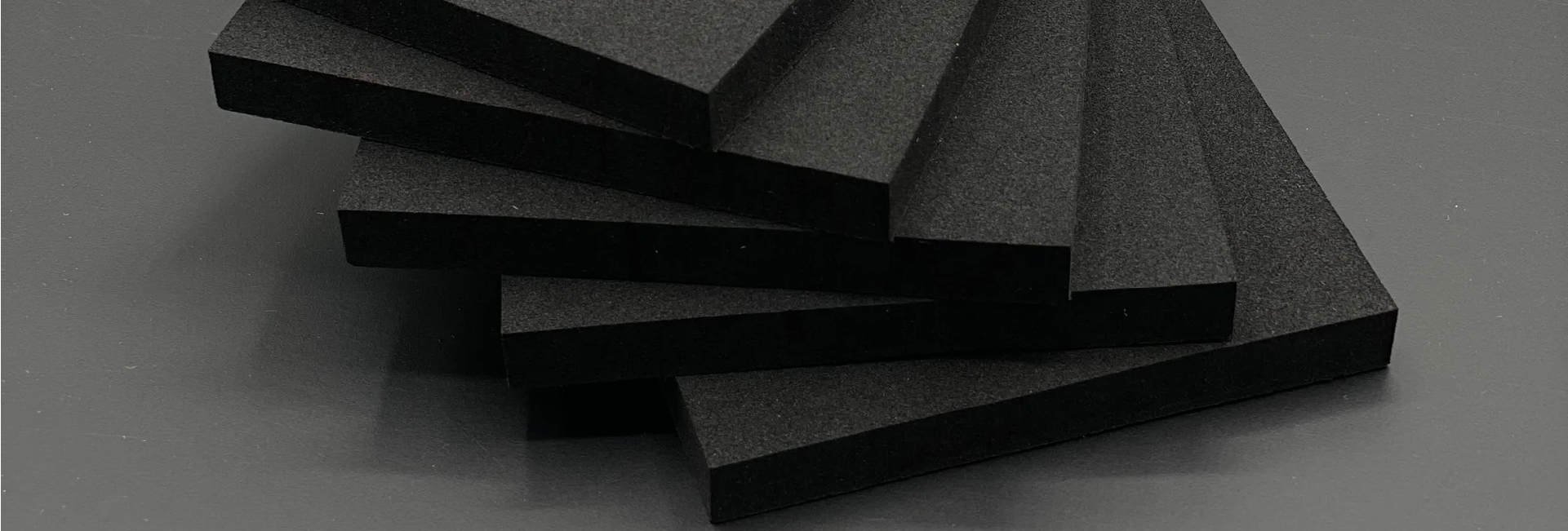
Closed-cell foam sheets resist water because their cells are sealed and not connected to each other, so water cannot wick through the material. That structure also gives them buoyancy, stable dimensions and good thermal resistance. It makes closed-cell foam the right choice for marine flotation, pipe lagging, HVAC gaskets and industrial seals wherever moisture is part of the job.
iFoam supplies closed-cell foam sheets in polyethylene (PE) and EVA, in densities of 30 to 120 kg/m³, cut to size at its Cape Town and Durban branches.
What Makes a Foam “Closed-Cell”?
A foam’s structure is set by how its gas-filled pockets, or cells, form during manufacture. In closed-cell foam, every cell is fully enclosed by a continuous polymer wall and no cell connects to its neighbour. In open-cell foam, the walls between cells are broken, creating a network that water and air can move through freely.
That sealed structure has practical consequences. Water cannot wick from cell to cell because there is no continuous path, so water absorption stays very low. The trapped gas gives the material buoyancy and stiffness. And because still gas conducts heat poorly and cannot circulate between sealed cells, the foam insulates well.
This guide covers industrial and commercial closed-cell foam sheet. Memory foam and mattress foams are open-cell by design and serve different needs. For a direct comparison, see the open-cell vs closed-cell foam guide.
Closed-Cell Foam Materials at a Glance
Several materials are made as closed-cell foam sheet. Each balances density, water resistance, UV resistance and cost differently, which decides where it works best.
| Material | Cell Structure | Water Absorption | UV Resistance | Typical Uses |
|---|---|---|---|---|
| PE foam (polyethylene) | Closed | Very low | Low | Packaging, pipe lagging, gaskets, flotation |
| IXPE or XLPE foam (cross-linked polyethylene) | Closed | Very low, with better recovery under load | Moderate | Underlay, gaskets, HVAC sealing, marine interiors |
| EVA foam (ethylene-vinyl acetate) | Closed | Very low | Good | Marine decking, boat padding, sports matting |
| XPS board (extruded polystyrene) | Closed, rigid | Near zero | Low | Rigid structural insulation in buildings |
PE foam covers the widest range of industrial uses because it comes in a broad spread of densities, with light grades for cushioning and dense grades for firm sheet. EVA earns its place where UV, sun and salt water demand better long-term performance, and cross-linked PE is chosen where a seal must hold up under sustained compression. iFoam’s closed-cell sheet range is PE and EVA; see PE vs EVA foam for help choosing between them.
Water Resistance and Waterproofing Applications
Closed-cell foam is water-resistant because of its cell structure, not because of any coating. With every cell sealed, there is no continuous path for liquid, so capillary action (liquid creeping through narrow connected spaces) cannot happen. Water on the surface of a closed-cell sheet stays on the surface.
In most sealing and lagging jobs the foam is also squeezed against a surface, which leaves even less exposed area for water to act on.
Practical waterproofing and moisture-control uses include:
- Pipe lagging: Foam is slit and wrapped around hot and cold water pipes to prevent condensation and limit heat loss, and it does not become waterlogged over the life of the installation.
- HVAC duct sealing and wrap: Closed-cell sheet around ductwork reduces thermal bridging and stops condensation on cold supply ducts in humid conditions.
- Electrical enclosure gaskets: Closed-cell foam compresses against enclosure flanges to seal out moisture without absorbing it and breaking down.
- Flange and pipe joint packing: Foam tape and sheet cut to shape fill gaps where rigid seals would crack under vibration or movement.
iFoam cuts closed-cell sheet to custom sizes, thicknesses and gasket shapes, which saves cutting on site and keeps repeat orders consistent.
Marine and Coastal Applications
Marine settings combine several stresses that rule out most open-cell foams. Salt water attacks many materials and adhesives, sunlight at sea is intense, and boat surfaces go through repeated wetting, drying, load and vibration. Closed-cell foams handle this by combining low water absorption with stability in salt water, and EVA adds good UV resistance.
That is why EVA sheet is the usual choice for marine decking and padding. Boat builders and refit yards use it for cockpit deck pads, swim platform covering, helm station matting and similar jobs. Its closed cells do not hold salt water between trips, and it resists surface damage from sun exposure. See EVA foam sheets for the range.
PE closed-cell foam does different marine jobs. Denser PE sheet lines fish boxes and cooler boxes to slow heat gain. Dock bumpers and fender profiles use PE because it absorbs knocks and springs back without taking on water. In small craft, closed-cell foam blocks are used as buoyancy fill in hull voids.
Both of iFoam’s branches, in Durban and Cape Town, serve active coastal boat-building and charter markets with year-round demand for marine foam.
Thermal Insulation Uses
Closed-cell foam insulates for the same reason it resists water. Gas trapped in sealed cells conducts heat poorly, and because the cells are not connected, the gas cannot circulate and carry heat across the material. The result is better insulation than open-cell foam of similar density.
Uses that rely on this include:
- Pipe lagging on hot and cold services: Closed-cell PE wrapped around pipework reduces heat loss from hot pipes and prevents condensation on cold pipes in warm, humid plant rooms and ceiling voids.
- Cold-room door seals and gasket strips: Gaskets cut from closed-cell sheet keep their thickness through repeated door closures, holding the seal without soaking up moisture.
- HVAC duct wrap: Closed-cell sheet on the outside of supply ducts reduces heat gain in warm ceiling spaces and stops condensation dripping onto ceilings below.
- Underfloor insulation: Cross-linked PE sheet is widely used as a thermal and sound underlay beneath laminate and engineered wood flooring because it resists being crushed by furniture and foot traffic.
Cross-linked grades have a particular advantage where insulation is under sustained load. Cross-linking adds extra bonds between the polymer chains, which improves resistance to compression set. A gasket or lagging wrap that keeps its thickness keeps insulating; one that flattens permanently loses both contact pressure and insulating air.
Gasket and Sealing Applications
Closed-cell foam beats open-cell foam in gaskets and seals for two reasons. Its sealed cells do not absorb the liquids, oils or gases that touch the seal, so it does not swell, break down or carry contamination. And it recovers its thickness when compression is released, keeping the contact force a seal needs through temperature changes and vibration.
Common gasket and sealing uses include:
- HVAC equipment flanges: Foam gaskets between flanged duct sections stop air leaks without adhesive, making installation and later removal easier.
- Electrical enclosure door seals: Closed-cell foam strips on enclosure frames help keep out dust and water when the thickness and density are specified correctly.
- Vehicle door and body trim: Closed-cell PE is cut to shape for door openings, cutting wind noise and water ingress at panel joints.
- Pipe joint packing rings: Rings cut from closed-cell sheet take up gaps at bolted pipe joints without squeezing out under bolt load.
Cross-linked PE is often specified for gaskets that need a long service life because it resists compression set better than standard PE over time. iFoam cuts gasket blanks and strips from closed-cell sheet to order; see gaskets and sealing strip, and the guide to choosing rubber gaskets and sealing strips for solid rubber options.
How to Choose the Right Closed-Cell Foam Sheet
Three questions decide the right closed-cell foam for a job.
1. What will it be exposed to? If the foam will face sunlight, salt water or long-term weathering, EVA is the better choice because of its UV resistance. If the exposure is mainly water or moisture without sun, standard PE is suitable and cost-effective. For chemical exposure, check compatibility for the specific chemical before specifying.
2. What load will it carry? Where the foam is held under constant compression, such as gaskets, door seals and compressed lagging, a grade with good compression set resistance keeps its sealing force for longer. Standard PE suits lightly loaded lagging, packaging and flotation.
3. What thickness and density does it need? Density sets stiffness, buoyancy and insulation per millimetre. Thicker sheet gives more insulation and more cushioning; thinner sheet suits tight spaces such as door seals and enclosure gaskets. The foam density chart explains how density affects performance.
In short: marine and sun-exposed jobs point to EVA; general waterproofing, pipe lagging and flotation point to PE; and gaskets under constant compression point to a dense, resilient grade.
Key Terms Explained
Closed-cell foam: Foam in which each gas-filled pocket is fully enclosed by an unbroken wall, so liquid and air cannot move between cells. This gives low water absorption, buoyancy and insulation.
Open-cell foam: Foam with broken cell walls that form a connected network. It is soft, absorbs sound and lets liquids and air through, so it is not suited to waterproofing or gaskets.
PE foam (polyethylene): A closed-cell foam made by expanding polyethylene. Light, low cost and chemically stable, and widely used for packaging, lagging and industrial sealing.
IXPE or XLPE (cross-linked polyethylene): Polyethylene foam in which the polymer chains are bonded together, improving compression set resistance, surface smoothness and chemical resistance compared with standard PE.
EVA (ethylene-vinyl acetate): A closed-cell foam that combines water resistance with UV resistance, flexibility and a pleasant surface feel. Widely used for marine decking, sports matting and outdoor padding.
Compression set: The permanent flattening left in foam after sustained compression, as a percentage of its original thickness. A low value means the foam recovers well, which is critical for gaskets and seals.
Capillary action: Liquid being drawn through narrow connected channels by surface tension. Open-cell foam is prone to it; closed-cell foam is not, because its cells are not connected.
ASTM D3575: The ASTM International standard of test methods for flexible foams made from olefin polymers such as PE. It covers properties including water absorption, density and compression set, and is a common reference on closed-cell foam data sheets.
Resources
- ASTM D3575, Standard Test Methods for Flexible Cellular Materials Made from Olefin Polymers. ASTM International.
- iFoam, closed-cell foam sheets.
- iFoam, open-cell vs closed-cell foam guide.
- iFoam, PE vs EVA foam.
- iFoam, EVA foam sheets.
- iFoam, foam density chart.
Frequently Asked Questions
Is closed-cell foam waterproof?
Closed-cell foam is highly water-resistant. Its sealed cells stop water wicking through the material, and absorption stays very low even after immersion. That makes it suitable for pipe lagging, duct sealing, enclosure gaskets and marine flotation. It is not a membrane in itself, but it performs well in standard wet industrial conditions.
What is the difference between PE foam and EVA foam?
PE (polyethylene) foam is the standard closed-cell sheet for packaging, lagging and general sealing. It is low cost and chemically stable. EVA (ethylene-vinyl acetate) foam adds UV resistance and a softer, more flexible surface at a higher cost. That makes it the better choice where sun and salt water are factors, such as marine decking and outdoor padding.
What does IXPE foam mean?
IXPE stands for irradiation cross-linked polyethylene foam. During manufacture the foam is exposed to an electron beam, which bonds the polymer chains together. This gives a smoother surface and much better resistance to compression set than standard PE, so IXPE is used where long-term sealing under load matters, such as HVAC gaskets and flooring underlay.
Can closed-cell foam float?
Yes. The gas trapped in sealed cells gives closed-cell foam buoyancy, and water cannot displace it. PE and EVA foam are used in dock fenders, fish box lids, hull void fill and flotation blocks because they stay buoyant after long immersion and do not become waterlogged or heavy.
Where can I buy closed-cell foam sheets in South Africa?
iFoam supplies closed-cell foam sheets from its Cape Town and Durban branches in PE and EVA, in densities of 30 to 120 kg/m³. Sheets can be cut to size, and gasket blanks and strips can be cut to your drawing for production or maintenance orders.
What is the difference between closed-cell foam and XPS board?
Both are closed-cell, but they behave very differently. XPS (extruded polystyrene) is a rigid board used mainly for structural insulation in buildings; it cannot be compressed, rolled or cut into gaskets. PE and EVA foams are flexible: they compress, recover, cut to shape and bend around curves. iFoam’s range covers the flexible foams.
How thick should closed-cell foam be for pipe lagging?
It depends on pipe size, temperature difference and how much heat loss or condensation risk is acceptable. As a rough guide, domestic hot water pipes often use around 13 to 19 mm, while larger industrial pipes or cold pipes in warm, humid spaces may need 25 mm or more. iFoam can advise on thicknesses for specific pipe sizes.
Can closed-cell foam be used outdoors?
Yes, with the right material. Standard PE has low UV resistance and its surface degrades in long-term direct sun, though its water resistance is not affected in the short term. For continuous sun exposure, EVA is the better choice. For any outdoor job, also consider surface temperatures and if a protective cover or cladding is needed.
What is compression set and why does it matter for gaskets?
Compression set is the permanent flattening left in foam after sustained compression is released. A gasket that flattens permanently loses contact pressure against the mating surface, letting air, moisture or dirt get past. Gaskets therefore need foam with low compression set, so they keep pushing back for their whole service life.
How does closed-cell foam perform in salt water?
PE and EVA are chemically stable in salt water, and their closed cells stop salt water soaking in. Repeated wetting and drying therefore does not build up salt inside the foam or make it swell. Sunlight is the main concern at sea, which is why EVA is preferred for exposed boat surfaces and PE for submerged or shaded jobs such as flotation fill.
What density of closed-cell foam is best for marine use?
It depends on the job. Deck padding and helm matting, which take foot traffic, need a firmer, more durable EVA. Fish box and cooler insulation suits a denser PE that slows heat gain. Flotation fill favours lighter grades for the best buoyancy for their weight. iFoam can recommend a density from its 30 to 120 kg/m³ range for your application.
Can closed-cell foam sheets be custom cut?
Yes. iFoam cuts closed-cell foam to custom sizes, thicknesses and shapes, including straight cuts to sheet size and gasket shapes from a drawing. Repeat production orders, such as enclosure gasket strips or marine deck pads, are cut consistently across the batch.
Final Thoughts
Matching the closed-cell foam to its environment is the key decision. Sun-exposed marine surfaces need EVA for its UV resistance. Gaskets under constant compression need a dense, resilient grade with low compression set. General waterproofing, pipe lagging and flotation are well served by PE at a lower cost. iFoam supplies closed-cell foam sheets in PE and EVA, cut to size from Durban and Cape Town. For sizes and densities, see iFoam’s closed-cell foam sheets.