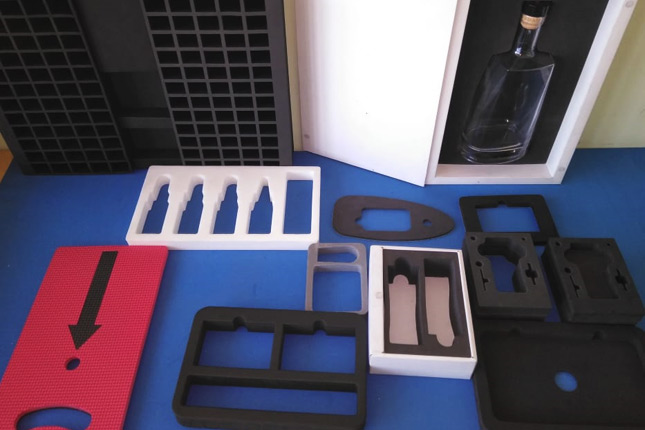
The main types of packaging foam are expanded polyethylene (EPE), cross-linked polyethylene (XLPE), ethylene vinyl acetate (EVA) and open cell polyurethane (PU). Polyethylene covers most shipped products, EVA suits premium and reusable cases, and PU cushions delicate surfaces. The product’s weight, its fragility and how often the packaging is reused decide which one fits.
iFoam has converted foam since 1997 and supplies packaging inserts from its Cape Town and Durban branches. Its closed cell polyethylene and EVA sheet comes in densities of 30 to 120 kg/m³, so the same material can act as a soft cushion or a firm, impact-resistant block. This guide explains how each foam type behaves and how to match it to what you ship.
How Packaging Foam Protects a Product
A carton can survive a drop while the product inside it breaks. Packaging foam does three jobs at once, and a foam that does only one of them well will fail somewhere on the route.
- Absorbing shock: On impact, the foam compresses and slows the product over a short distance, so it does not stop dead against the carton wall.
- Holding the product still: Movement inside the box causes scuffs, chipped corners and loose parts, so a snug cavity stops the product rattling through hours of road vibration.
- Spreading the load: Cartons are stacked in vans and trucks, and foam spreads that weight across a wider area so one corner does not take it all.
Cut foam is not the only cushioning option. Bubble wrap, loose fill and moulded polystyrene all do some of these jobs, and moulded polystyrene works well for high-volume products of one fixed shape. Cut foam stands out on the second job, because it holds the product in the same position every time. For what happens to polystyrene after delivery, read is polystyrene recyclable.
Three properties decide how well a foam does those jobs. Density, in kg per cubic metre, sets how much energy the foam can soak up before it is squashed flat. Cell structure sets its character. Closed cell foam traps air in sealed bubbles, so it springs back and resists moisture, while open cell foam lets air move through and feels softer. The iFoam guide to open cell and closed cell foam covers that split in detail.
Compression set is the third property. It is the permanent loss of thickness after foam has been squeezed for a long time. A foam with poor compression set fits well on day one and rattles loose after a few trips.
EPE Foam
EPE foam is expanded polyethylene that has not been cross-linked. It is the sheet, plank and roll found around appliances, furniture legs and machined parts, and it is the workhorse of one-way shipping.
EPE is light, closed cell and resilient, so it takes repeated knocks and ignores damp. It usually costs less than XLPE, which matters when the foam is thrown away at the other end.
The trade-off sits in the cells. Without cross-linking they are larger and less even, so the surface feels slightly coarse and the foam dents and tears more easily. That is no problem for a block wedged into the corner of a carton. It matters more for an insert the customer sees when they open a presentation box.
iFoam’s AERO grade sits on this side of the line. It is a closed cell extruded foam at 33 kg/m³ that is not cross-linked, unlike iFoam’s PE and EVA grades, and its listed uses include void fillers, cushioning and packaging. For corner blocks, end caps and void fill on one-way shipments, a foam like this does the job well.
XLPE Foam (Cross-Linked Polyethylene)
Two polyethylene sheets at the same density can feel completely different in the hand. The difference is cross-linking.
XLPE foam is polyethylene whose molecular chains are bonded to one another during manufacture. That gives a finer, more even cell structure, a smoother surface and better durability. It cuts with clean edges, which is why it turns up in tool cases, instrument boxes and inserts that are opened and closed again and again.
iFoam’s PE33 and PE45 grades are closed cell polyethylene and, unlike AERO, they are cross-linked. PE45 is the firmer of the two and is listed for tooling inserts, packaging and impact resistance. The full range is on the closed cell foam sheets page.
EPE and XLPE Compared
Both are polyethylene, both are closed cell and both protect well. The choice comes down to who sees the foam and how often it is used.
| EPE | XLPE | |
|---|---|---|
| Cross-linked | No | Yes |
| Cell structure | Larger, less even | Fine, even |
| Surface | Slightly coarse | Smooth |
| Durability | Good | Better, suits reuse |
| Relative cost | Usually lower | Usually higher |
| Typical use | Corner blocks, end caps, void fill | Visible inserts, reusable cases, tool trays |
Choose EPE when the foam is hidden and the trip is one-way. Choose XLPE when the customer sees the insert on opening the box, or when the case comes back for another trip.
EVA Foam
EVA is often filed under craft supplies, but in packaging it does more serious work.
EVA foam is made from ethylene vinyl acetate. It is tougher, more flexible and more rubbery than polyethylene foam, so in a cavity it grips the product instead of just surrounding it. It is also made in a wide range of colours, which is why it shows up in presentation boxes and two-colour layered inserts.
Those qualities suit premium cases, tool inserts and presentation boxes, where the foam is part of what the customer sees. Recovery matters too. iFoam’s EVA45 grade is described as having good memory and recovery after compression, so a cavity keeps its shape after the product has been lifted in and out many times. The EVA foam sheets page lists the wider range.
The limit is cost. EVA usually costs more than PE foam, so it is less common for one-way shipping, where the insert is thrown away on arrival. Use it where the foam is part of the product experience or where the case will be reused.
PU Foam
Polished lenses, lacquered wood and painted parts need something softer than a firm closed cell foam. That is where PU foam comes in.
PU foam is open cell polyurethane, the soft, sponge-like foam whose cells connect, so air moves through it and it compresses under light pressure. It does its best work under light, delicate items. For a full side-by-side of the two most common packaging foams, read PE foam vs PU foam.
Open cell foam absorbs water where closed cell foam does not, so pair it with a sealed bag or a closed cell outer layer when a parcel may get wet. For heavy items, a firmer closed cell foam carries the load better. iFoam cuts packaging inserts in both: closed cell foam for firm, impact-resistant support under heavy items, and open cell foam for softer support under delicate ones.
Packaging Foam Comparison Table
Side by side, the pattern is plain: polyethylene for most protective work, EVA where looks and reuse matter, and PU for softness.
| Foam | Cells | Feel | Best for | Watch for |
|---|---|---|---|---|
| EPE | Closed, not cross-linked | Light, slightly coarse | One-way shipping, corner blocks, void fill | Dents and tears more easily than XLPE |
| XLPE | Closed, cross-linked | Smooth, resilient | Visible inserts, reusable cases, tool trays | Usually costs more than EPE |
| EVA | Closed | Tough, rubbery, many colours | Premium cases, tool inserts, presentation boxes | Costs more than PE foam |
| PU | Open | Soft, sponge-like | Delicate surfaces, light fragile items | Absorbs water |
The density inside each type matters as much as the type itself, and the foam density chart explains how to read those numbers. For foams beyond packaging, see foam types explained.
Matching Packaging Foam to the Product
Most foam failures are not material failures. They are matching failures: the right foam at the wrong density, or the right density cut to the wrong shape. Choosing between the types of packaging foam starts with the product, not the foam.
Weight and Fragility
Foam protects by compressing. A heavy product needs a firmer, denser foam so it does not crush the cushion flat on the first drop and hit the carton wall anyway. A light product needs a softer foam that it is heavy enough to compress. The target is a foam that gives part of the way on impact and recovers afterwards.
Myth: The densest foam gives the most protection.
Reality: Foam that is too firm for a light item acts like a solid block, and the item feels every knock.
iFoam’s closed cell grades show how density and hardness line up:
| Grade | Material | Density | Hardness | Listed uses |
|---|---|---|---|---|
| PE33 | Cross-linked PE | 33 kg/m³ | Around 17 Shore C | Insulation, seals and gaskets, packaging, camping mats |
| EVA45 | Cross-linked EVA | 45 kg/m³ | Around 17 Shore C | Seals and gaskets that need good recovery |
| PE45 | Cross-linked PE | 45 kg/m³ | Around 26 Shore C | Tooling inserts, packaging, impact resistance |
| T5 | PE and EVA blend | 80 kg/m³ | Around 30 Shore C | Seals and gaskets, firm packaging inserts |
| AERO | Extruded, not cross-linked | 33 kg/m³ | Not published | Void fillers, cushioning, packaging |
Shore C is the hardness scale used for foam, and a higher reading means a firmer surface under your thumb. EVA45 is denser than PE33 yet reads the same hardness.
Key principle: Density alone does not tell you how a foam will feel, so check density and hardness together.
A quick starting point by product:
- Heavy, sturdy items: Tools and machined parts suit the firmer closed cell grades, such as PE45 or T5.
- Mid-weight items with a finished surface: XLPE or EVA, cut to a close-fitting cavity, protects the product and presents it well.
- Light, fragile items: A softer grade such as PE33 works well, or open cell foam for delicate surfaces.
Courier Handling and Repeat Use
A parcel sent between Cape Town and Durban is handled many times. It is collected, sorted at a hub, loaded onto a linehaul truck, offloaded, sorted again and loaded into a delivery vehicle. Each step is a chance for a drop, a corner impact or a heavy carton stacked on top. Then there is the road, with long hours of vibration on national routes and, for some deliveries, a gravel road at the end.
That journey changes the foam choice in three ways:
- Plan for more than one drop: Foam with poor recovery may protect against the first impact and not the third, while closed cell grades with good memory, such as EVA45 and T5, recover between knocks.
- Fill every gap: Hours of road vibration work a loose product against its packaging. A cavity cut to the product’s shape holds it still, where loose fill settles and shifts.
- Allow for damp: Parcels can wait in damp depots, which is where closed cell foam’s resistance to water pays off.
Repeat use is the other half. Returnable cases for tools, test equipment and samples go out and come back many times, so compression set becomes the deciding property. Cross-linked PE and EVA hold their shape better over repeat use than non-cross-linked foam, which is why XLPE and EVA are the usual choice for reusable cases.
Turning a Foam Choice Into Custom Inserts
Choosing the material is half the job. The cut is the other half. Good foam packaging inserts hold the product so closely that it cannot move, with enough foam around it to absorb a knock.
iFoam cuts inserts by die-cutting, CNC or laser cutting, and makes them in runs rather than one at a time. The right method depends on the shape, the level of detail and the size of the run. The guide on how foam packaging inserts protect products covers insert design in more depth, and foam cut to size explains how custom foam cutting works.
Resources
- iFoam, Packaging Inserts.
- iFoam, Foam Packaging Inserts Guide.
- iFoam, PE Foam vs PU Foam: Which Is Better for Packaging?.
- iFoam, Open Cell vs Closed Cell Foam.
- iFoam, Foam Density Chart: Understanding the Metrics.
- iFoam, Closed Cell Foam Sheets.
- iFoam, Foam Types Explained.
Frequently Asked Questions
What is the best foam for packaging?
It depends on the product. Most protective packaging uses polyethylene, because it is light, closed cell and shrugs off damp. Delicate surfaces do better in soft open cell PU. Premium or returnable cases often move up to EVA or cross-linked PE for a cleaner finish and a longer life.
What is the difference between EPE and XLPE foam?
The difference is cross-linking. In XLPE the polymer chains are bonded together, which produces smaller, more uniform cells and a smoother, harder-wearing foam. EPE skips that step, so it is usually the cheaper option and has a slightly rougher feel. Hidden, single-trip packaging tends to use EPE, while visible or reusable inserts tend to use XLPE.
Is EVA foam good for packaging?
Yes, for the right job. EVA is more elastic than polyethylene and keeps its shape well after repeated compression, so it works for cases that are packed and unpacked many times. Its higher price means it is rarely chosen for throwaway packaging.
Can PU foam get wet?
Open cell PU soaks up water, because its connected cells let moisture in. A parcel may sit in a damp depot or arrive in the rain. In that case, wrap the product in a sealed bag first, or put a layer of closed cell foam on the outside of the pack.
Final Thoughts
The right choice between the types of packaging foam comes down to how each one behaves under the product’s weight, on the road and over repeat trips. Pick the foam for the product first, then cut it to fit. Send iFoam the product’s dimensions, its weight and how it will travel, and request a quote for custom packaging inserts.