
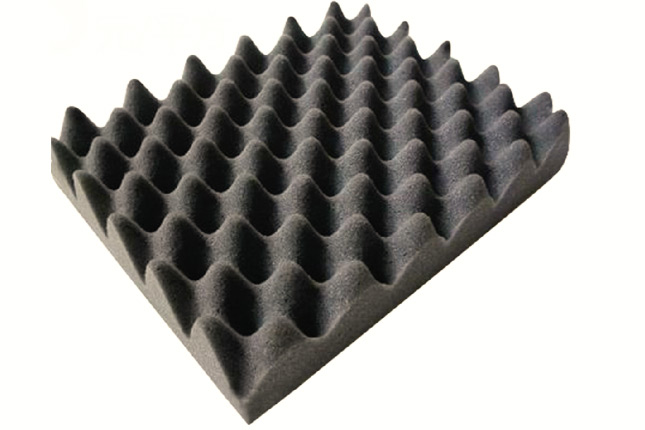
Acoustic foam panels reduce flutter echo, standing waves, and excessive reverberation by absorbing sound energy within a room. Wedge and pyramid panels perform similarly in real-world conditions. Thickness and total coverage matter more than shape. Bass traps in the corners handle low frequencies. First reflection points on the side walls are the highest-priority placement.
A 2-inch wedge panel absorbs nearly twice as much mid-range energy as a 1-inch pyramid panel. Thickness is the single most consequential variable when selecting acoustic foam.
What Acoustic Foam Panels Actually Do (and What They Do Not)
Acoustic foam panels convert sound energy into heat through friction as sound waves pass through the open-cell foam structure. The result is a reduction in echo, flutter, and reverberation within the treated room. The panels absorb sound energy within the room; they do not block sound from passing through walls, floors, or ceilings.
This distinction is fundamental. When sound pressure builds up in a poorly treated room, it reflects off hard parallel surfaces and arrives at the listener multiple times, at varying delays. The audible result is smeared transients, uneven frequency response, and difficulty distinguishing detail in a recording or mix. Acoustic foam panels address exactly these problems.
The problems acoustic foam panels solve:
- Flutter echo: rapid, repeating reflections between two parallel hard surfaces (walls, floor, ceiling).
- Standing waves: resonant frequency build-up at specific room dimensions, causing certain notes to sound louder or quieter than they should.
- Excessive reverberation: a long, diffuse tail of reflected energy that obscures transient detail.
The problems acoustic foam panels cannot solve:
- Sound leaking from an adjacent room, a neighbouring apartment, or external traffic noise.
- Airborne transmission through structural elements.
For guidance on blocking sound transmission, see the complete guide to soundproofing a room.
The Main Panel Types
Wedge Panels
Wedge panels are rectangular foam tiles with a surface profile of parallel ridges running in one direction. They are the most widely used format in acoustic treatment and represent the practical standard for most installations.
Available in 1-inch, 2-inch, and 3-inch thicknesses (25mm, 50mm, and 75mm), the 2-inch specification is the established norm for mid-range absorption. Thicker panels absorb energy at progressively lower frequencies, which is why thickness selection matters more than surface profile selection.
Most 2-inch wedge panels achieve an NRC (Noise Reduction Coefficient) of 0.70 to 0.85, making them suitable for home studios and commercial acoustic treatment where the target is an NRC of 0.65 or above.
Best applications: general wall coverage, first reflection points, rear wall treatment. Wedge panels are also the most cost-effective entry point for treating a room.
Pyramid Panels
Pyramid panels use a surface profile of small, evenly spaced points rather than parallel ridges. The resulting geometry exposes marginally more surface area to the room than an equivalent wedge panel.
Under laboratory conditions, pyramid panels absorb roughly 8 to 12% more high-frequency energy than equivalent wedge panels. In real rooms with furniture, object diffusion, and varied angles of incidence, the difference is nearly undetectable to the human ear.
Performance and application overlap strongly with wedge panels at the same thickness. If you are choosing between the two based on acoustic performance alone, thickness is the more consequential variable.
For a direct comparison of surface profiles and their measured performance differences, see the egg crate vs pyramid foam comparison.
Egg Crate Foam
Egg crate foam uses a convoluted profile of peaks and valleys, visually resembling the interior of an egg carton. It is available in thinner profiles than most wedge or pyramid products and is commonly used in cost-sensitive applications.
NRC performance for egg crate foam is typically 0.25 to 0.40 at standard thicknesses. At 1.5 inches (approximately 38mm), the NRC rises to approximately 0.45. At 2.5 inches (approximately 63mm), the NRC reaches approximately 0.60. These figures place egg crate below the 0.65 NRC threshold recommended for a functional home studio at standard thicknesses.
Egg crate foam is not the optimal choice for primary treatment surfaces. It does, however, have legitimate applications: budget coverage of large areas, lining storage rooms, and vocal recording booths where cost is the primary constraint and the volume of material compensates for lower per-panel NRC.
For a detailed breakdown of how egg crate compares to pyramid and wedge profiles, see the egg crate vs pyramid foam comparison.
Bass Traps
Bass traps are specialised acoustic panels targeting low frequencies below 300 Hz. Low-frequency energy is the most difficult acoustic problem to address in small rooms because bass wavelengths are long and require substantial material thickness to absorb effectively.
Effective bass trapping requires a minimum thickness of 4 inches (approximately 100mm). At this thickness, bass traps can achieve an NRC of 0.80 to 1.0 in the low-frequency range. Thinner panels do not provide meaningful absorption below 300 Hz, regardless of surface profile.
Standard placement is all four vertical corners of the room. Corners are where bass energy concentrates most heavily because they are the intersection point of three boundary surfaces. Without corner bass traps, even a room with comprehensive mid and high-frequency treatment will have uneven low-frequency response.
iFoam cuts foam to custom sizes, which is useful for fitting non-standard corner dimensions or unusually proportioned rooms.
Broadband Absorbers
Broadband absorbers are thick, flat or lightly profiled panels, typically 3 to 4 inches (75 to 100mm), designed to absorb across a wider frequency range than standard wedge or pyramid panels. They capture some upper bass energy in addition to mid and high frequencies.
Broadband absorbers are used on rear walls, as ceiling cloud panels positioned between speaker and listener, and in locations where wide-range coverage is required without the specific corner placement of bass traps. They function as the practical middle ground between thin wedge panels and dedicated corner bass traps.
Does Shape Matter? The Honest Answer
The laboratory data is clear: pyramid panels absorb roughly 8 to 12% more high-frequency energy than equivalent wedge panels under controlled conditions. The real-room data is equally clear: in a furnished room with varied surface angles and incidental object diffusion, the difference is nearly undetectable to the human ear.
What matters far more than shape: a 2-inch wedge panel absorbs nearly twice as much mid-range energy as a 1-inch pyramid panel.
Total surface coverage and placement position determine the acoustic outcome in any real room. Shape selection is a secondary consideration.
Clients regularly ask whether they should choose wedge or pyramid foam. The honest answer is that choosing the right thickness and placing the panels at first reflection points will have ten times more impact than the surface profile. I have treated rooms with each format and measured no meaningful difference at equivalent thickness.
Acoustic Treatment Specialist
Mini case study: A Johannesburg-based podcast producer covered both side walls and the rear wall of a 4 x 4 metre room with 1-inch pyramid panels. Recordings remained muddy with audible flutter echo. After replacing the installation with 2-inch wedge panels at the first reflection points and adding 4-inch bass traps in all four corners, intelligibility improved measurably and the flutter echo resolved completely. The shape change was irrelevant; the thickness and placement change was decisive.
Myth vs Reality: It is a common assumption that adding more panels always improves sound quality. In practice, over-treating a room with thin panels on every surface creates an acoustically dead space that sounds unnatural. Excessive high-frequency absorption without corresponding low-frequency control via bass traps can make a room sound dull and unbalanced. The target is controlled, even absorption across the frequency range, not maximum coverage.
Panel Comparison by Type
| Shape | Typical NRC | Best For | Common Thickness |
|---|---|---|---|
| Wedge | 0.50–0.85 (at 2 inches) | General coverage, first reflections | 1–3 inches (25–75mm) |
| Pyramid | 0.55–0.90 (at 2 inches) | First reflections, aesthetic preference | 1–3 inches (25–75mm) |
| Egg Crate | 0.25–0.60 | Budget coverage, large areas | 1.5–2.5 inches (38–63mm) |
| Bass Trap | 0.70–1.0 (low freq) | Corner low-frequency control | 4+ inches (100mm+) |
| Broadband Absorber | 0.70–0.95 | Rear wall, cloud, wide-range control | 3–4 inches (75–100mm) |
Where to Place Acoustic Foam Panels
First Reflection Points (Highest Priority)
First reflection points are the wall and ceiling locations where sound from the speakers or source bounces directly toward the listening or recording position. Treating these surfaces reduces comb filtering, improves stereo imaging, and eliminates the most audible reflections in a room.
On the side walls, the first reflection points sit at ear height, approximately at the midpoint between the speaker and the listener. The ceiling between the speaker and the listener is the secondary first-reflection surface.
To locate first reflection points precisely, hold a mirror flat against the side wall and move it along the wall at ear height. Wherever you can see the speaker’s tweeter reflected in the mirror, that location is a first reflection point. Mark it and place a panel there.
A minimum of one panel per first reflection point is the starting specification. Larger panels or two-panel arrangements at each point provide greater coverage margin.
Rear Wall Treatment
The rear wall reflects sound back toward the listener after it has passed the listening position. Untreated, this produces a strong reflection that arrives at the listener with a short delay, causing smearing of transient detail.
The standard approach is broadband absorption on the rear wall. A combination of absorption and diffusion is also appropriate, with diffusion preventing the room from sounding acoustically dead. Absorption is the simpler and more predictable approach at this level of treatment.
Corners (Bass Traps)
All four vertical floor-to-ceiling corners are the primary bass trap locations. Ceiling-to-wall and floor-to-wall junctions (tri-corners) are secondary placements that extend the effectiveness of the treatment.
Mount bass traps floor-to-ceiling where possible. Where full-height installation is not practical, fill the corner from the ceiling downward by at least 2 to 3 feet (600 to 900mm), as bass energy concentrates most heavily at wall and ceiling junctions.
Coverage Percentage Guidelines
Treating first reflection points and all four corners constitutes the minimum effective baseline for a functional acoustic treatment installation.
Full broadband treatment typically covers 25 to 40% of total room surface area.
A practical budget approach: prioritise first reflection points and corner bass traps first. Add general rear wall coverage in the next phase, followed by ceiling cloud panels and incremental fill coverage as budget allows.
How Much Foam Do You Need?
The simplest starting point for a home studio or podcast room is a panel count based on the treatment priority order.
Priority order:
- First reflection points on both side walls (2 panels per side, 4 panels total as a minimum).
- Ceiling first reflection point between speaker and listener (2 to 4 panels).
- All four corner bass traps, floor-to-ceiling or partial (4 corner units at minimum).
- Rear wall coverage (4 to 6 panels for a typical home studio rear wall).
- Front wall treatment and additional fill coverage as budget allows.
For a standard home studio room in the 10 to 20 square metre range, the minimum functional installation typically requires 12 to 16 standard wedge or pyramid panels plus 4 corner bass trap units.
For larger installations, for commercial facilities, or for rooms with non-standard dimensions, a more structured approach is appropriate. iFoam supplies panels cut to custom sizes and in volume quantities. Contact iFoam directly for larger installation enquiries and cut-to-size specifications.
Acoustic Foam in South Africa: Sourcing and Sizing
iFoam has operated as an industrial and commercial foam supplier since 1997, with facilities in Durban and Cape Town. Cut-to-size capability is available for buyers who require non-standard panel dimensions, corner-specific profiles, or volume orders that do not align with standard packaged product dimensions.
The supply base covers home studios, podcast facilities, broadcast rooms, commercial acoustic installations, and trade buyers requiring consistent material specification across multiple projects.
Buyers in the Western Cape can enquire through iFoam’s Cape Town acoustic foam service.
Explore iFoam’s full range of acoustic foam options or request a custom-cut quote at iFoam acoustic and soundproofing products.
Key Terms Explained
NRC (Noise Reduction Coefficient): A single-number rating that expresses how much sound energy a material absorbs, measured on a scale of 0.00 to 1.00. An NRC of 0 indicates no absorption; an NRC of 1.0 indicates complete absorption of incident sound energy. NRC is measured across a frequency range (typically 250 Hz to 2,000 Hz) and averaged into a single value. It does not describe low-frequency performance, which is why bass trap specifications often list separate low-frequency NRC data.
First reflection points: The specific locations on walls and ceilings where sound from a speaker or source bounces directly to the listening or recording position. These are the highest-priority placement targets for acoustic panels because treating them eliminates the most audible and most time-delayed reflections in the room.
Flutter echo: A rapid, repeating series of reflections between two parallel hard surfaces, such as opposite walls or floor and ceiling. Flutter echo produces a characteristic “metallic” or “ringy” quality in recordings. It is one of the problems acoustic foam panels are most effective at resolving.
Standing waves: Resonant conditions that occur when a sound frequency’s wavelength aligns with a room dimension. At these frequencies, constructive interference causes the sound to appear significantly louder at certain positions in the room; destructive interference causes it to appear quieter at others. Bass traps address the low-frequency standing waves that are most audible in small rooms.
Bass trap: An acoustic panel or assembly of sufficient thickness (4 inches or more) to absorb sound energy at low frequencies, typically below 300 Hz. Standard placement is in the vertical corners of the room, where bass energy concentrates. Bass traps address the low-frequency resonance problems that thinner panels cannot reach.
Comb filtering: An acoustic artefact produced when a direct sound and a delayed reflection of the same sound arrive at the listener simultaneously. The interference between the two signals causes some frequencies to cancel and others to reinforce, producing a frequency response graph resembling the teeth of a comb. Treating first reflection points reduces the reflections responsible for comb filtering.
Cloud panel: A horizontal acoustic panel mounted at the ceiling, positioned between the speaker and the listener. The cloud panel addresses the ceiling first reflection point and is typically a broadband absorber of 3 to 4 inches thickness.
Resources
Internal:
- iFoam acoustic foam and soundproofing products
- Egg crate vs pyramid foam comparison
- Acoustic foam in Cape Town
- Complete guide to soundproofing a room
External:
- Acoustical Society of America. https://acousticalsociety.org
- Sweetwater Sound’s acoustic treatment guide. https://www.sweetwater.com
- Acoustic Fields measurement-based room treatment methodology. https://acousticfields.com
- Real Traps published NRC data and treatment guides. https://www.realtraps.com
Frequently Asked Questions
What is the difference between egg crate and pyramid acoustic foam?
Egg crate foam uses a convoluted peak-and-valley surface profile. Pyramid foam uses evenly spaced pointed projections. In measured acoustic performance, pyramid panels absorb roughly 8 to 12% more high-frequency energy under laboratory conditions; in real rooms the difference is negligible. The more significant difference is NRC at standard thicknesses: egg crate typically achieves 0.25 to 0.40, whereas pyramid panels at equivalent thickness typically achieve 0.55 to 0.90. Egg crate is appropriate for budget coverage and large-area applications. Pyramid panels are suited to primary treatment positions such as first reflection points.
Do acoustic foam panels reduce noise from neighbours?
No. Acoustic foam panels absorb sound energy within the room where they are installed. They do not block airborne sound transmission through walls, floors, or ceilings. Noise from neighbours travels as structural vibration and airborne pressure through building materials. Reducing this type of noise transfer requires mass, decoupling, and airtight sealing, not surface absorption. For an overview of what is involved in reducing noise transmission, see the complete guide to soundproofing a room.
Where should I put acoustic foam in a recording studio?
The priority order is: first reflection points on both side walls at ear height, the ceiling position between speaker and listener, all four vertical corners with bass traps, and then the rear wall. This sequence addresses the most audible problems first and provides the greatest acoustic return per panel installed. The first reflection points are identified using the mirror method: wherever you can see the speaker’s tweeter reflected on the wall, place a panel.
How thick should acoustic foam panels be?
For mid-range absorption (approximately 500 Hz to 4,000 Hz), 2-inch (50mm) panels are the practical standard. A 2-inch panel absorbs nearly twice as much mid-range energy as a 1-inch panel. For low-frequency control below 300 Hz, bass traps require a minimum of 4 inches (100mm). Thinner panels are not effective at bass frequencies regardless of surface profile. If budget limits the choice, invest in thicker panels at fewer, higher-priority positions rather than thin panels across the entire room.
What NRC rating do I need for a home studio?
For a functional home studio acoustic treatment installation, aim for panels with an NRC of 0.65 or above at the target frequency range. Most 2-inch wedge or pyramid panels achieve NRC 0.70 to 0.85, which exceeds this threshold. Egg crate foam at standard thicknesses typically falls below 0.65 and is therefore not recommended as the primary panel for a home studio unless used at 2.5-inch thickness or above. Bass traps require their own NRC assessment in the low-frequency range, where 4-inch units can reach 0.80 to 1.0.
What is NRC and how is it measured?
NRC stands for Noise Reduction Coefficient. It is a single-number rating that expresses the average sound absorption performance of a material, measured on a scale of 0.00 (no absorption) to 1.00 (complete absorption). NRC is determined by laboratory testing under ASTM C423 or equivalent standard, measuring absorption at octave-band centre frequencies (typically 250 Hz, 500 Hz, 1,000 Hz, and 2,000 Hz) and averaging the results. An NRC of 0.80 means the material absorbs 80% of incident sound energy across the measured range. NRC does not describe performance below 250 Hz; low-frequency specifications are often stated separately in bass trap data sheets.
Can I use acoustic foam panels on a ceiling?
Yes. Ceiling treatment is an effective part of a complete acoustic treatment plan. The ceiling position between the speaker and the listener, known as the cloud panel position, is the second-priority first reflection surface after the side walls. Ceiling panels should be mounted securely, using appropriate adhesive, z-clip hanging systems, or timber framing, depending on panel weight and ceiling construction. Broadband absorbers of 3 to 4 inches thickness are appropriate for ceiling cloud positions. Standard 2-inch wedge or pyramid panels can also be used. Always confirm the mounting method is appropriate for the panel weight and ceiling substrate before installation.
How many acoustic foam panels do I need for a home studio?
A minimum functional installation for a home studio room of 10 to 20 square metres requires approximately 12 to 16 standard panels plus 4 corner bass trap units. The breakdown by priority: 4 panels for side wall first reflection points (2 per side), 2 to 4 panels for the ceiling cloud position, 4 corner bass trap units, and 4 to 6 panels for the rear wall. This covers the treatment positions that provide the greatest acoustic return. Additional panels for front wall and general fill coverage can be added incrementally. iFoam can supply panels in volume quantities and cut to custom sizes for specific room requirements.
What is flutter echo and how do acoustic panels fix it?
Flutter echo is a rapid, repeating series of reflections that occur between two parallel hard surfaces, typically opposite walls or the floor and ceiling. It produces an audible metallic or ringy quality, particularly noticeable after a sharp transient sound such as a handclap. Flutter echo is caused by sound bouncing back and forth between the parallel surfaces with insufficient absorption to dissipate the energy. Acoustic foam panels fixed to one or both of the parallel surfaces interrupt this reflection cycle. Even partial coverage at the first reflection points of the affected surfaces is sufficient to eliminate most flutter echo. Complete elimination typically requires treatment on both opposing surfaces.
What is the difference between acoustic foam and soundproofing foam?
The terms are used interchangeably in retail contexts but refer to different acoustic functions. Acoustic foam panels reduce echo, flutter, and reverberation within a room by absorbing sound energy. They treat the acoustic quality of the interior space. Soundproofing refers to reducing sound transmission between spaces, such as from one room to another or from outside to inside. Effective soundproofing requires mass (dense materials), decoupling (separating structural elements), and airtight sealing. Acoustic foam panels alone do not provide meaningful soundproofing. A room can be acoustically well-treated and still allow significant sound transmission through its walls. For guidance on sound transmission control, see the complete guide to soundproofing a room.
Final Thoughts
Placement and thickness determine the acoustic outcome of any treatment installation; panel shape is a secondary variable. Start with first reflection points on the side walls and corners treated with 4-inch bass traps, and you will address the most audible problems in the room before spending on broader coverage. For custom-cut acoustic foam panels and volume supply in South Africa, explore iFoam’s full range at iFoam acoustic and soundproofing products.