
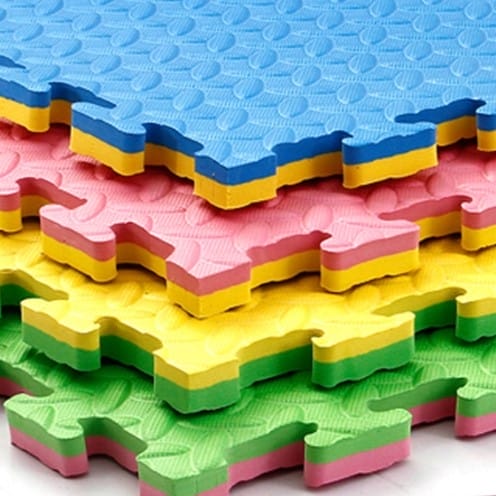
EVA foam (Ethylene Vinyl Acetate) is one of the most versatile closed-cell polymer materials available to industrial buyers, trade customers, and capable makers. It is used across protective packaging, industrial anti-fatigue matting, gym flooring, cosplay armour fabrication, sports padding, marine flotation, and construction sealing. Its closed-cell structure makes it waterproof, shock-absorbing, and heat-formable, with a standard density of 38 kg/m³ that suits both light-duty craft work and heavy industrial applications. The density range extends from 0.05 to 0.50 g/cm³ (3 to 31 lbs/ft³), giving buyers considerable scope to match material specification to load requirements.
iFoam has supplied EVA foam to industrial and trade buyers across South Africa from its Durban and Cape Town branches since 1997.
What Makes EVA Foam Different
EVA foam is a closed-cell, rubber-like polymer formed from Ethylene Vinyl Acetate copolymer. The defining structural feature is its closed-cell architecture: each air pocket within the foam is sealed and isolated from adjacent cells. This means the material is non-porous and water-resistant even under direct liquid exposure. Unlike open-cell polyurethane foam, as explained in our open-cell vs closed-cell foam guide, EVA does not absorb moisture into its matrix, which extends service life significantly in wet or outdoor environments.
According to Omnexus polymer data from the SpecialChem material database, EVA copolymers exhibit excellent chemical resistance, UV stability, and flexibility across a broad temperature range, making the material appropriate for both indoor industrial and outdoor applications.
The key properties of EVA foam are: waterproof, shock-absorbing, heat-formable (shapeable with a heat gun for cosplay and prop applications), UV-resistant, lightweight, chemically resistant, buoyant, and resistant to cracking under repeated load cycles.
Standard density is 38 kg/m³, placing it in the mid-range of EVA’s full density spectrum of 0.05 to 0.50 g/cm³ (3 to 31 lbs/ft³). iFoam supplies EVA foam in sheets, rolls, and cut-to-size formats from both its Durban and Cape Town branches. For a comparison with polyethylene foam grades, see PE vs EVA foam: how to choose the right density.
Key specification: Standard EVA foam density is 38 kg/m³. This figure suits the majority of general industrial, gym matting, and light-duty packaging applications.
12 Practical Uses for EVA Foam
1. Protective Packaging and Shock-Absorbing Inserts
Custom-cut EVA foam inserts protect fragile equipment, electronics, precision instruments, and manufactured components during transport and storage. The closed-cell structure absorbs impact forces without permanent compression, which makes inserts reusable across multiple shipments rather than single-use. EVA foam is also used for automotive insulation panels and under-bonnet component protection.
Density is selected to match the fragility and mass of the item being protected: lighter, more fragile items require a softer grade to maximise deformation on impact; heavier industrial components require a firmer grade that resists full compression. iFoam supplies cut-to-size EVA for protective foam inserts and custom packaging inserts for both industrial and trade customers.
Mini case study: A Durban-based electronics distributor replaced single-use expanded polystyrene inserts with custom-cut EVA foam inserts across its export packaging line. Over twelve months, return rates attributed to transit damage reduced by an internally documented margin, and the inserts were reused for an average of seven dispatch cycles before replacement. The moisture-resistant surface also withstood humid container conditions without deformation.
2. Industrial Anti-Fatigue Matting
Factory floors, assembly lines, warehouse packing stations, and commercial kitchen environments use EVA anti-fatigue matting to reduce worker fatigue and musculoskeletal strain over prolonged standing shifts. The cushioning action absorbs the impact of standing on concrete or hard tile surfaces over periods of four or more hours. EVA’s closed-cell structure and moisture resistance make it directly suited to wet processing environments such as food production, fish processing, and chemical handling areas where other foam types would absorb fluids and degrade. Thicker, higher-density EVA grades are specified for heavy industrial use; moderate-density material suits light commercial environments.
3. Gym and Exercise Mats
EVA foam delivers consistent comfort and joint support for floor exercises, yoga practice, martial arts training, home gym flooring, and fitness studio surfacing. Its moisture resistance means it does not absorb sweat, making it far easier to clean and sanitise than open-cell alternatives. The material is lightweight relative to its cushioning depth, which simplifies installation and reconfiguration of gym spaces.
Interlocking tile formats are the most common supply format for gym flooring because they allow modular installation without adhesive. Standard density of approximately 38 kg/m³ suits most gym and exercise mat applications. For buyers in KwaZulu-Natal, iFoam supplies gym flooring in Durban in standard and cut-to-size formats.
4. Cosplay Armour and Props
EVA foam is the preferred material for cosplay armour fabrication across the hobbyist and professional prop-making community. The properties that make it ideal are: it is heat-formable with a standard heat gun, allowing complex curves and angular armour shapes to be achieved without specialist tooling; it is lightweight enough to wear for extended periods; it cuts cleanly with a craft knife or hot wire cutter; and it accepts primer, paint, and sealant finishes well.
A thickness of 5 to 6 mm is ideal for main armour pieces, including chest plates, pauldrons, and shin guards. Thinner sheets of 2 to 3 mm are used for fine detailing, edge trimming, and layered surface texture. Buyers searching for craft foam sheets in South Africa will find that iFoam supplies EVA sheets in multiple thicknesses suited to both armour and detail work.
5. Craft and School Projects
EVA foam sheets are widely used in school projects, model-making, display board construction, and general craft work. The material cuts cleanly with scissors or a craft knife, accepts most craft adhesives and acrylic paints without priming, and is available in a range of thicknesses and colours. Craft foam sheets are cost-effective for detailed handcraft where precision and clean edges are required. The material’s light weight and lack of sharp-edge risk make it appropriate for supervised school use across age groups.
Myth vs. reality: A persistent misconception is that craft foam is only for children’s school projects or decorative hobbyist use. In practice, EVA foam in sheet form is the same base material used in industrial anti-fatigue matting, orthotic insoles, and marine flotation components. The difference lies in the density and thickness specified, not the polymer itself.
6. Marine and Water Sports Flotation
EVA’s buoyancy and UV resistance make it well suited for marine applications, including boat seat padding, swim platform deck surfacing, boat fenders, kayak padding, and flotation aids for water sports equipment. The closed-cell structure resists waterlogging even after extended or repeated immersion, which distinguishes it from open-cell foams that would absorb water and lose buoyancy over time. UV stability prevents surface degradation from prolonged sun exposure, which is a common failure mode for less stable foam materials used outdoors.
7. Children’s Play Mats and Soft Flooring
Interlocking EVA foam tiles provide cushioned play area surfaces for children’s rooms, crèches, play centres, and nursery school environments. The lightweight, easy-clean surface absorbs the impact of falls and reduces hard-floor injury risk. The closed-cell surface does not harbour moisture or bacterial growth in the way that textured open-cell surfaces can.
8. Automotive Sound Deadening and Sealing
EVA foam is used in automotive interiors for door panel sealing strips, under-carpet dampening layers, boot liner cushioning, and vibration isolation between body panels. The closed-cell structure prevents moisture ingress into vehicle cavities, extending the service life of the seal and the surrounding structure. Adhesive-backed EVA strip and sheet formats simplify installation in production or aftermarket fitment.
9. Construction and Building Seals
EVA foam strip and sheet material is used as expansion joint filler, window frame sealing compound, door surround draught exclusion, and void filler in construction and renovation applications. The material compresses to fill irregular or non-uniform gaps and recovers shape over time after decompression, maintaining the seal without adhesive bonding in many applications. Its moisture resistance prevents the seal from degrading when exposed to rain or condensation.
10. Sports Equipment Padding
Shin guards, helmet liners, shoulder pads, and protective components in contact sports use EVA foam for shock absorption at low overall weight. The material is moulded or laminated into shaped protective inserts that conform to body geometry. Density and thickness are selected by the specific application: lower density for comfort-oriented products such as helmet padding; higher density for primary impact resistance in shin and shoulder protection.
11. Camping and Outdoor Gear
Closed-cell EVA foam sleeping mats, portable seat pads, and pack frame back panels are a camping staple because the material is lightweight, moisture-resistant, and provides thermal insulation from cold ground. Unlike open-cell sleeping pads, EVA mats do not absorb ground moisture overnight. UV resistance extends outdoor service life across multiple seasons without significant surface degradation.
12. Medical and Orthotic Applications
EVA foam is used in shoe insoles, orthopaedic footwear construction, prosthetic socket padding, and pressure-relief cushioning products. Density is selected to balance cushioning and structural support: softer grades provide comfort and conformability; firmer grades resist bottoming out under body weight over extended wear periods. The material’s moisture resistance prevents the rapid degradation that occurs in open-cell foam when used in footwear environments.
Choosing the Right EVA Foam Density and Thickness
Density determines the stiffness and load-bearing capacity of the foam. Thickness determines the depth of cushioning available before the material compresses to its limit under load. Selecting both figures correctly for the application is the primary specification decision for any EVA foam purchase.
As documented in the British Plastics Federation Plastipedia polymer reference, the relationship between polymer density and mechanical performance is consistent across closed-cell foam families: higher density correlates with greater resistance to compression set, higher load-bearing capacity, and generally firmer tactile feel. Lower density materials are softer, lighter, and more compliant but offer less resistance to sustained loads.
The table below summarises recommended thickness and density guidance by application. The 38 kg/m³ figure for gym and exercise mats is the density figure confirmed against verified specifications; other density descriptors use relative terms.
| Application | Recommended Thickness | Density Guidance | Key Property |
|---|---|---|---|
| Protective packaging inserts | 10 to 50 mm (application-dependent) | Match to item fragility | Shock absorption |
| Industrial anti-fatigue matting | 15 to 25 mm | Medium-high density | Sustained load bearing |
| Gym / exercise mats | 8 to 15 mm | Approx. 38 kg/m³ | Cushioning, moisture resistance |
| Cosplay armour pieces | 5 to 6 mm | Low-medium density | Heat-formability, light weight |
| Cosplay detailing | 2 to 3 mm | Low density | Precision cutting |
| Marine / water sports | 10 to 20 mm | Medium density | Buoyancy, UV resistance |
| Children’s play mats | 10 to 15 mm | Medium density | Cushioning, easy clean |
| Construction seals | 5 to 20 mm (strip) | Medium density | Compressibility, recovery |
| Sports equipment padding | 5 to 15 mm | Medium-high density | Shock absorption |
| Orthotic insoles | 6 to 10 mm | Medium-firm density | Pressure relief, durability |
iFoam supplies EVA foam with cut-to-size capability from EVA foam Durban and EVA foam Cape Town, allowing buyers to specify precise dimensions rather than cutting down from standard sheet formats.
The most common specification error we encounter is buyers selecting EVA foam thickness without reference to density. A 20 mm sheet at low density will bottom out under anti-fatigue mat loads within weeks. Matching density to the sustained load requirement first, then selecting thickness for cushioning depth, produces a far more durable outcome.
Industrial Foam Specialist
Where to Buy EVA Foam in South Africa
iFoam operates from Durban and Cape Town, supplying EVA foam sheets and rolls to industrial buyers, trade customers, and capable DIY users since 1997. Both branches offer cut-to-size service for custom dimensions, which removes the need for buyers to purchase oversized sheet formats and cut to requirement on site.
For buyers in KwaZulu-Natal and surrounding regions, EVA foam is available from our Durban branch. For buyers in the Western Cape, EVA foam is available from our Cape Town branch.
To view our closed-cell foam sheets and browse the full EVA foam sheet range, including thickness and density options available for supply, contact iFoam directly through either branch.
Key Terms Explained
EVA (Ethylene Vinyl Acetate): The copolymer from which EVA foam is produced. Ethylene and vinyl acetate monomers are combined at varying ratios to produce a rubber-like polymer with adjustable flexibility, density, and chemical properties. Higher vinyl acetate content increases softness and transparency.
Closed-cell foam: A foam structure in which each individual air cell is sealed and isolated from adjacent cells. The result is a non-porous, moisture-resistant material. EVA foam is a closed-cell material.
Open-cell foam: A foam structure in which cells are interconnected and open to adjacent cells. Open-cell foams absorb liquids and air, making them breathable but unsuitable for moisture-exposed applications. Polyurethane upholstery foam is typically open-cell.
Heat-forming: The process of applying direct heat from a heat gun or oven to EVA foam to render it temporarily pliable, allowing it to be pressed into curves, angles, or complex shapes. The material retains the new shape on cooling. This is the principal fabrication technique in cosplay armour and prop-making.
Shore hardness: A measure of a material’s resistance to permanent indentation. EVA foam is typically measured on the Shore A scale; higher Shore A numbers indicate a firmer material. Shore hardness and density are related but not equivalent: density describes mass per unit volume, while Shore hardness describes surface resistance.
Density (kg/m³ and g/cm³ relationship): Density is expressed either in kilograms per cubic metre (kg/m³) or grams per cubic centimetre (g/cm³). These are equivalent measures: 38 kg/m³ equals 0.038 g/cm³. The g/cm³ unit is more common in polymer data sheets; the kg/m³ unit is more common in industrial foam supply specifications.
NRC (Noise Reduction Coefficient): A standardised measure of a material’s ability to absorb sound energy, expressed as a value between 0 (total reflection) and 1 (total absorption). EVA foam’s closed-cell structure limits sound absorption relative to open-cell foams; its primary acoustic application is vibration damping rather than noise absorption. NRC is more relevant to open-cell acoustic foam specifications.
Resources
Internal:
- Closed-cell foam sheets, iFoam product range
- EVA foam Durban, Durban branch availability
- EVA foam Cape Town, Cape Town branch availability
- Open-cell vs closed-cell foam explained
- PE vs EVA foam: how to choose the right density
- Packaging inserts
- Gym flooring Durban
External:
- Omnexus / SpecialChem, EVA polymer data. https://omnexus.specialchem.com
- British Plastics Federation Plastipedia, polymer definitions. https://www.bpf.co.uk/plastipedia/
Frequently Asked Questions
What is EVA foam made of?
EVA foam is made from Ethylene Vinyl Acetate, a copolymer produced by combining ethylene and vinyl acetate monomers. The full name is Ethylene Vinyl Acetate foam. The polymerisation process produces a rubber-like closed-cell material with adjustable density, flexibility, and chemical resistance. The ratio of vinyl acetate in the copolymer influences the final softness and clarity of the material.
Is EVA foam waterproof?
Yes. EVA foam is waterproof. Its closed-cell structure means each air pocket within the foam is sealed and non-porous. Water cannot be absorbed into the material matrix, which makes EVA foam water-resistant under direct liquid exposure and resistant to waterlogging even after extended immersion. This distinguishes it from open-cell polyurethane foam, which absorbs water readily.
How do you cut and shape EVA foam for cosplay?
EVA foam cuts cleanly with a sharp craft knife, a scalpel, or a hot wire cutter. For straight cuts, a steel rule and a fresh blade produce the cleanest edges. To heat-shape EVA foam, apply a heat gun on a medium setting at a distance of 5 to 10 cm until the surface becomes pliable. The material can then be pressed into curves, wrapped around formers, or folded to desired angles. Remove heat and hold the shape until the foam cools and sets. The process is repeatable: the foam can be reheated and reshaped if the initial result is not satisfactory.
What thickness EVA foam do I need for cosplay armour?
For main armour pieces such as chest plates, back plates, pauldrons, and bracers, 5 to 6 mm EVA foam provides sufficient rigidity and structural presence without excessive weight. For surface detailing, panel lines, raised decoration, and fine layering, thinner sheets of 2 to 3 mm allow precision cutting and cleaner joins. Many cosplay armour builds layer both thicknesses: the base structure at 5 to 6 mm with surface detail added in 2 to 3 mm.
Is EVA foam safe for children’s play mats?
EVA foam is widely used in children’s play mat products globally and is generally considered safe for this application. It does not absorb moisture, does not harbour bacterial growth in the way textured open-cell surfaces can, and presents no sharp-edge risk. For any safety-critical or regulated children’s product application, buyers should verify current applicable standards with the relevant authority.
Where can I buy EVA foam sheets in South Africa?
iFoam supplies EVA foam sheets and rolls from its branches in Durban and Cape Town. Both branches offer cut-to-size service for custom dimensions. Buyers in KwaZulu-Natal can source EVA foam from the Durban branch; buyers in the Western Cape can source EVA foam from the Cape Town branch. iFoam has supplied industrial and trade buyers since 1997.
What is the difference between EVA foam and polyurethane foam?
EVA foam is a closed-cell polymer: non-porous, waterproof, and moisture-resistant. Polyurethane foam (PU foam) is most commonly open-cell in its standard upholstery grade: porous, breathable, and able to absorb liquids. EVA is considerably more moisture-resistant, UV-stable, and buoyant than open-cell PU foam. PU foam is generally softer and more conformable for seating and bedding applications. The two materials are not interchangeable for moisture-exposed or outdoor applications, despite appearing similar in density and tactile softness at similar grades.
Is EVA foam the same as craft foam?
Yes, in most commercial contexts. Craft foam sheets sold in hobby and stationery retailers are typically EVA foam in low-density, thin-sheet formats. The polymer is identical to the EVA used in industrial anti-fatigue matting, orthotic insoles, and marine flotation. The difference is in the density, thickness, and surface finish specified for the end application. Buyers seeking craft foam sheets in South Africa for cosplay, school projects, or model-making are purchasing the same base material in a thinner, lighter specification.
Can EVA foam be painted?
Yes. EVA foam accepts acrylic paints, spray paints, and foam-specific sealers. For cosplay and prop applications, a layer of flexible sealant or contact adhesive is typically applied to the surface first; this closes any surface pores from cutting, reduces paint absorption, and improves paint adhesion and flexibility. Without a sealer coat, paint applied directly to cut EVA can crack at fold lines when the foam flexes.
How long does EVA foam last outdoors?
EVA foam is UV-resistant and moisture-resistant, giving it considerably longer outdoor service life than open-cell foams. In marine, camping, and construction seal applications, EVA foam products regularly last several years without significant degradation under normal sun and rain exposure. The precise service life depends on UV intensity, thermal cycling, and the specific density and formulation of the material. In South African coastal and high-UV inland environments, iFoam advises specifying a grade confirmed for outdoor UV stability for long-term exterior applications.
What is EVA foam density and why does it matter?
Density is the mass of the foam per unit of volume, expressed in kilograms per cubic metre (kg/m³) or grams per cubic centimetre (g/cm³). Standard EVA foam density is 38 kg/m³ (equivalent to 0.038 g/cm³). Higher density means more polymer material per unit volume: the foam is firmer, more resistant to compression, and better suited to sustained load applications. Lower density means softer, lighter foam suited to cushioning and lightweight applications. Selecting the correct density for the load and duration of use is the primary specification decision for any EVA foam application. The full density range for EVA foam is 0.05 to 0.50 g/cm³ (3 to 31 lbs/ft³).
Can EVA foam be recycled?
EVA foam recycling is technically possible but not widely available through standard municipal kerbside recycling programmes in South Africa. EVA polymer can be reprocessed into granules for use in new moulded products, but collection and processing infrastructure for post-consumer EVA foam is limited compared to PET or HDPE plastic recycling. Industrial off-cuts from manufacturing processes are more commonly suitable for collection by specialist foam recyclers. Buyers with significant volumes of EVA foam off-cuts or end-of-life products should contact a specialist polymer recycler for disposal guidance.
Final Thoughts
EVA foam is one of the few materials that spans domestic craft use, industrial anti-fatigue matting, orthotic applications, and marine flotation within a single polymer family. The closed-cell structure is the property that drives its suitability across all of these applications: it provides waterproofing, shock absorption, buoyancy, and UV stability that open-cell alternatives cannot match in moisture-exposed or outdoor environments. iFoam supplies EVA foam sheets, rolls, and cut-to-size formats from Durban and Cape Town to industrial buyers and trade customers across South Africa. Contact iFoam directly to specify the density and thickness required for your application.